Best Mattresses for Couples With Different Firmness: 4 Picks (2026)
Affiliate disclosure: As an Amazon Associate I earn from qualifying purchases. MedHelperPro may earn a commission from eligible purchases made through links in this guide, at no extra cost to you. Affiliate availability does not affect our selections. Read the full disclosure.
Research note: Product selections are based on published specifications, policies, and independent evidence unless a guide explicitly describes hands-on testing.
Verified related listing: For two Twin or Twin XL mattresses on a flat, nonadjustable setup, Amazon lists the FeelAtHome 10-inch Bed Bridge with adjustable strap, ASIN B07YYYT832. Amazon showed no featured offer when checked on November 7, 2026, so check the seller, availability, exact 10-inch variant, and return terms. A bridge can soften the center seam, but it also reduces separation between the two surfaces and is not a solution for independently articulating bases.
Buy the adjustment system that matches how often your preferences change.
Saatva Solaire is the strongest starting point when both partners want to change firmness from the bed. Naturepedic EOS Classic is better for buyers who want separate organic latex and coil layers that can be exchanged. Nest Bedding Sparrow is the lower-cost connected King choice, while BEDGEAR M3 makes the left and right coil units replaceable. None is a proven universal winner for motion isolation.
SHARED BED
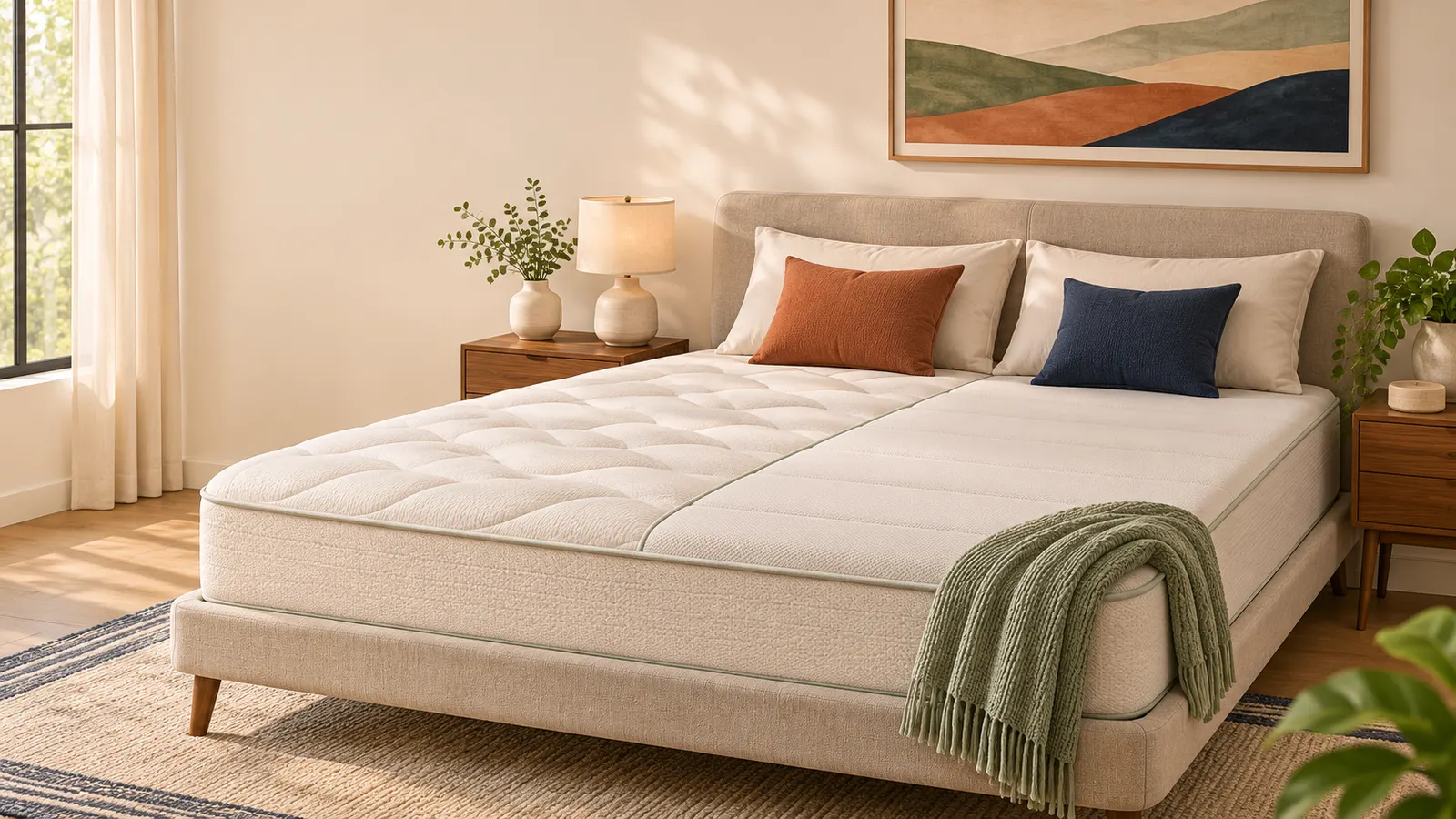
A mattress for mismatched preferences should give each sleeper an appropriate surface and keep movement from crossing the bed. Those are separate jobs. Split foam, adjustable air, or separate coils can change firmness by side, but shared upper layers may still transmit movement.
Quick decision summary
- Best for frequent firmness changes: Saatva Solaire, with 50 air settings on both sides in Queen and larger sizes.
- Best organic modular option: Naturepedic EOS Classic, with five comfort levels and free comfort-layer exchanges during its 100-night trial.
- Best connected King on a lower budget: Nest Bedding Sparrow Internal Split, offered in King and Cal King with Plush, Medium, and Firm combinations.
- Best replaceable coil system: BEDGEAR M3, with four left and right Independent Suspension choices in Queen and larger sizes.
- Best low-cost route: two Twin XL mattresses, but only when a center seam, separate covers, and a flat or split-compatible base are acceptable.
How we chose these mattresses
We reviewed current specifications, firmness menus, setup, prices, trials, return fees, warranties, and replaceable components on November 7, 2026. A mattress qualified only if its manufacturer offered different left and right firmness in a shared size.
Motion evidence received separate treatment. Saatva says its dual air chambers virtually eliminate motion transfer, yet two current independent reviews reached different conclusions. Tom's Guide reported good motion isolation after a three-week review, while Mattress Clarity reported poor motion isolation in its testing. That disagreement is more useful than pretending one result settles the issue.
We did not receive these mattresses, so we did not run the proposed edge-to-edge motion test. We provide a repeatable home-trial check instead. Manufacturer pages supply construction and ownership terms; independent reviews are used only when the tested model is clear. Affiliate availability did not affect rank.
Comparison: four ways to create different firmness on each side
| Mattress | How each side changes | Eligible shared sizes | Motion evidence | Trial and warranty | Skip it if |
|---|---|---|---|---|---|
| Saatva Solaire | Remote-controlled air chambers with 50 settings per side | Queen and larger; split and upper-flex options also sold | Independent reviews conflict | 365 nights; no minimum; $99 return pickup fee; lifetime limited warranty | You want a nonpowered, simple mattress |
| Naturepedic EOS Classic | Separate latex and coil comfort modules in five levels | Queen, King, and Cal King offer left and right choices | Firmness-dependent; latex and coils remain responsive | 100 nights after 30 nights; free trial-period layer swaps; 25-year limited warranty | You want easy remote changes or a low entry price |
| Nest Bedding Sparrow Internal Split | Separate Plush, Medium, or Firm foam comfort layers under one cover | King and Cal King only | Low transfer reported on an earlier build, not the current 8-inch coil version | 365 nights after 30-night adjustment; limited lifetime warranty | You need Queen size or daily adjustment |
| BEDGEAR M3 | Interchangeable left and right coil units, levels 0.0 through 3.0 | Queen, King, Cal King, and split variants | No comparable current-model independent result found | Opened returns within 30 days with $199 fee; 10-year limited warranty | You need a long, fee-free comfort trial |
Prices move often and the sizes above are not equivalent. As a dated budget reference, the direct pages showed $1,911.75 for a Sparrow King Internal Split, $2,499.99 for an M3 Queen, $3,359.20 for an EOS Classic Queen, and $4,264 for the selected Solaire configuration when checked. These included active promotions. Use the current configured total, not a homepage starting price, when comparing.
Which mattress fits each kind of couple?
1. Saatva Solaire: best for frequent firmness changes
The Saatva Solaire uses separate air chambers in Queen and larger sizes, with each sleeper controlling one of 50 settings. That is a different ownership model from swapping foam or coils: a partner can make small changes without opening the cover or ordering a part. Saatva also lists a flippable comfort layer with a latex side and a memory-foam side, though flipping it is a whole-bed setup decision.
The product page includes free delivery and setup and a lifetime limited warranty with full coverage during the first three years. Saatva's trial policy gives online mattress buyers 365 nights with no mandatory minimum, but a return carries a $99 pickup processing fee. The pumps, hoses, remotes, and air chambers also add service questions that conventional foam and coil beds avoid.
A standard Queen lets partners change firmness while sharing one surface. Split King and Split Cal King versions are the clearer choice for independent head and foot articulation. Our adjustable bed base guide explains why two Twin XL bases, sync cables, frame clearance, and return rules need to be checked as one system.
Best for: couples who expect preferences to change, want fine adjustments, and value in-room setup. Skip it if: you prefer a mattress without powered components, dislike the possibility of service calls, or want independent articulation without buying the correct split configuration.
2. Naturepedic EOS Classic: best organic modular option
Naturepedic's EOS Classic places configurable latex and coil modules inside a zippered encasement. Queen, King, and Cal King buyers can select Plush, Medium, Cushion-Firm, Firm, or Extra-Firm separately for the left and right. The mechanism is mechanical rather than electronic: changing the feel means opening the mattress and moving or replacing a layer.
The direct policy offers a 100-night trial after a 30-night minimum, free returns, and free comfort-layer exchanges during that period. Naturepedic also sells replacement layers later. Its 25-year limited warranty covers defined defects, not a 25-year comfort promise.
Sleep Foundation's EOS evaluation found motion performance varied with the selected firmness and noted the responsive feel of latex and coils. That makes sense for this construction, but it does not predict every left and right pairing. A Plush side next to Extra-Firm creates a different boundary than two neighboring settings.
Best for: buyers who prioritize certified organic materials, want replaceable comfort modules, and are willing to handle layers. Skip it if: you want a remote, need a lower price, have a latex allergy, or cannot comfortably lift and reposition mattress components.
3. Nest Bedding Sparrow Internal Split: best connected King value
Nest Bedding's Sparrow Signature Hybrid offers Internal Split combinations only in King and Cal King. The current menu pairs Plush, Medium, and Firm comfort layers beneath one connected cover. The configured King price was the lowest among the four complete mattresses in this guide when checked, although promotions and size differences make that a snapshot rather than a permanent ranking.
The current mattress is 14 inches with an 8-inch pocketed-coil unit. Eligible returns start after a 30-night adjustment period within a 365-night trial. A one-time Lifetime Renewal Exchange replaces a comfort layer; the limited lifetime warranty covers defined defects.
NapLab reported low motion transfer in a Sparrow review, but its tested unit used the earlier support-core specification. We did not carry that score to the current 8-inch coil build. The connected cover can reduce the obvious gap of two separate Twin XL mattresses, but it also means movement may still cross the shared top.
Best for: couples who want one King surface, three clear firmness choices, and a renewable comfort layer without paying for air controls. Skip it if: you need Queen size, want more than three firmness levels, require independent base articulation, or cannot manage a 141-pound King mattress after delivery.
4. BEDGEAR M3: best replaceable coil system
The BEDGEAR M3 changes support through separate left and right coil modules. Level 0.0 is Firm, 1.0 is Medium Firm, 2.0 is Medium Plush, and 3.0 is Plush. The direct page offers those pairs in Queen, King, Cal King, and split configurations. The zippered cover is machine-washable, while the internal suspension units can be removed for access and cleaning.
This changes support at the coil level, but it creates work. A Queen chassis was listed at 73 pounds, and each Queen suspension unit at 20 to 30 pounds. Swapping a side is a physical project, not a nightly adjustment.
The return window is the largest compromise. BEDGEAR says an opened M3 can be returned within 30 days with a $199 fee; unopened returns have 100 days. The warranty is 10 years. That is much less time to judge two configurations than the other three picks provide, so a local showroom trial has unusual value here. We found independent testing of an earlier M3 edition, but not a methodologically comparable result for this current configuration.
Best for: couples who want distinct left and right coil support, a washable cover, and access to internal modules. Skip it if: you need a long fee-free trial, cannot lift the parts, or want a motion-isolation result backed by current independent testing.
Budget route: two Twin XL mattresses
Two Twin XL mattresses form the same nominal 76 by 80-inch footprint as a standard King. Each partner can choose a separate construction, not just a firmness option within one brand. This can cost less, especially when each side can be replaced on its own. It is also the only route here that fully separates the support cores.
The tradeoffs are a center seam, matching heights, and separate bedding. A bridge can soften the seam on a flat base, but it reconnects the surfaces and may reduce motion separation. Do not bridge independently moving adjustable bases.
If one partner only needs a modest surface change, a topper may be cheaper than a mattress. Most toppers cover the whole bed, though, so they do not solve opposing preferences unless the product is made for one side or the bed is already split. Our mattress topper guide explains what a topper can change and why it cannot repair sagging support.
Run an edge-to-edge motion check during the trial
Couples use the edges, center boundary, and different firmness settings. Test those real conditions during the return period:
- Set both sides to the intended firmness and use the actual base, protector, and sheets.
- Have one partner lie in a normal position at the far edge while the other sits down, rolls over, and gets out on the opposite edge.
- Repeat with the resting partner near the center boundary, where shared cover material may transmit more movement.
- Swap sides and repeat. Different body weights and firmness settings can change the result.
- Test ordinary actions on separate nights, including turning, getting up, and sitting on the edge. Write down disturbances rather than relying on one dramatic demonstration.
- Decide before the return deadline, leaving time to contact support and follow any minimum-use requirement.
This is a comfort check, not a laboratory test. Do not place breakable objects or open liquids on the bed. If heat is the larger problem, compare airflow and return terms in our mattress guide for hot sleepers.
What to check before buying
Internal split, true split, or adjustable air
An internal split separates selected components inside one cover. A true split uses two mattresses and supports independent base movement. Adjustable air avoids moving heavy layers but adds pumps and serviceable parts.
Firmness labels are not standardized
One company's Medium is not another's. Body weight and position change how a setting feels. Side sleepers often prefer more surface cushioning, while stomach and back sleepers may prefer less sink, but those are starting points. See our side-sleeper comparison and fit-first mattress guide.
Trial terms matter more than the headline length
Check the minimum nights, pickup or processing fee, original-owner rule, condition requirements, and whether exchanges end the trial. A 365-night label can still include a fee or a required adjustment period. A showroom purchase may follow the retailer's policy rather than the manufacturer's online terms.
Plan for component access and long-term service
Ask what one replacement side costs after the trial, who pays shipping, whether a technician is required, and what happens if the model changes. Keep the law label and proof of purchase.
Check the whole support system
Confirm slat spacing, center support, foundation type, adjustable-base compatibility, frame capacity, mattress weight, and total bed height. A split mattress also needs the correct sheet sizes. Do not assume a bed bridge, topper, or King protector is compatible with moving halves.
Read certifications narrowly
CertiPUR-US certifies qualifying flexible polyurethane foam, not an entire mattress, a latex layer, coils, or comfort. Organic textile and latex claims should name the standard, certified scope, and certificate holder. Separately, the U.S. Consumer Product Safety Commission explains that mattresses and mattress sets are subject to federal flammability rules. Compliance is a safety baseline, not proof of comfort or durability.
Limitations of this guide
MedHelperPro did not receive, sleep on, open, adjust, or measure motion on these mattresses. We did not assign scores or treat manufacturer firmness scales as comparable. Independent evidence did not cover every current build, and Solaire motion reports conflict. Prices, promotions, stock, materials, policies, and exact variants can change after publication.
Useful questions before you choose
Can one mattress really have two firmness levels?
Yes. A shared cover can contain separate air chambers, foam modules, latex layers, or coil units. The amount of separation differs. Ask which layers are independent and which cross the full width.
Is split firmness the same as a Split King?
No. Split firmness can exist inside one connected King or Queen mattress. A Split King is two Twin XL mattresses. The true split is usually required for fully independent head and foot articulation.
Which type isolates motion best?
No type wins in every configuration. Separate mattresses create the clearest structural break, but a bridge, shared topper, frame contact, or synchronized base can reconnect movement. Foam often dampens motion better than responsive latex or coils, yet design details and firmness settings matter.
Can a topper make only one side softer?
A standard Queen or King topper changes both sides. A Twin XL topper can change one half of a Split King, but it may add a height mismatch at the center. Measure thickness and edge shape before buying.
Should pain determine the mattress choice?
A mattress can affect comfort, but this guide does not diagnose or treat pain. Persistent pain, weakness, numbness, or sleep disruption deserves evaluation by a qualified clinician. Use the mattress trial for comfort and function, not as a medical test.
Sources
- Saatva: Solaire firmness settings, sizes, construction, compatibility, price, trial, delivery, and warranty summary
- Saatva: online mattress trial duration, minimum-night rule, and return pickup fee
- Tom's Guide: three-week Solaire review and motion-isolation finding
- Mattress Clarity: Solaire test method and conflicting motion-isolation finding
- Naturepedic: EOS Classic firmness menu, modular construction, sizes, price, trial, layer swaps, and warranty summary
- Naturepedic: current returns and exchange policy
- Sleep Foundation: EOS construction and firmness-dependent performance testing
- Nest Bedding: Sparrow Internal Split combinations, current build, price, trial, renewal exchange, and warranty summary
- Nest Bedding: detailed return, exchange, foundation, and warranty terms
- NapLab: Sparrow review and disclosure that the tested support core predates the current specification
- BEDGEAR: M3 firmness modules, sizes, care, weights, price, returns, and warranty summary
- CertiPUR-US: certification scope for flexible polyurethane foam
- U.S. Consumer Product Safety Commission: mattress definitions and federal flammability requirements
Before you buy
- Choose between a connected internal split, two separate mattresses, or powered air adjustment.
- Compare the configured size total, not the advertised starting price.
- Read minimum nights, fees, pickup rules, and exchange effects before ordering.
- Confirm base, frame, sheets, weight, and articulation compatibility.
- Run the same edge, center, and get-out-of-bed motion check on both sides during the trial.