Best Sleep Tracker Watches: 4 Practical Picks (2026)
Affiliate disclosure: As an Amazon Associate I earn from qualifying purchases. MedHelperPro may earn a commission from eligible purchases made through links in this guide, at no extra cost to you. Affiliate availability does not affect our selections. Read the full disclosure.
Research note: Product selections are based on published specifications, policies, and independent evidence unless a guide explicitly describes hands-on testing.
Related lower-cost watch, not a top pick: The exact marketplace catalog identity below was verified as the black Garmin vivoactive 5, model 010-02862-10, ASIN B0CG6NR413. It is an older watch with up to 11 days of published battery life. Check current price, seller, stock, and return terms before ordering.
Match the watch to your phone first, then protect the overnight charge.
Apple Watch Series 12 is the strongest iPhone choice. Pixel Watch 5, preferably the 45mm model, is the best general Android choice. Galaxy Watch9 makes more sense inside Samsung's ecosystem. Garmin Venu 4 45mm is the battery-first option for either phone platform. None is a sleep laboratory, and no published maximum tells you exactly how much charge one night will consume.
THEN BATTERY
A watch can estimate sleep duration, stages, heart rate, heart rate variability, breathing, and temperature trends. It cannot see the brain, eye, and muscle signals measured during polysomnography. A 2025 meta-analysis of 24 studies and 798 participants found significant differences between consumer wrist trackers and laboratory testing for total sleep time, sleep efficiency, sleep latency, and wake time after sleep onset. Use the numbers to notice patterns, not to diagnose a condition or change medication.
Quick decision summary
- Best for iPhone: Apple Watch Series 12, if a daily charging routine is realistic.
- Best for most Android users: Google Pixel Watch 5 45mm for its longer published battery, fast charge, and broad Android support.
- Best for a Galaxy phone: Samsung Galaxy Watch9, especially when Samsung Health features matter more than charge speed.
- Best for battery continuity: Garmin Venu 4 45mm for up to 12 days in smartwatch mode and up to four days with the display always on.
- Best budget move: keep a compatible watch you already own, or consider the verified older vivoactive 5 listing only after checking its live price and policy.
How do the four sleep tracker watches compare?
Product pages, prices, software requirements, and policies were checked October 26, 2026. Battery figures are manufacturer maximums unless an independent observation is identified. Always-on display, overnight blood oxygen, GPS workouts, cellular use, signal quality, temperature, and battery age can reduce runtime.
| Watch | Phone fit | Published battery and charge | Case for sleep | Checked starting price | Skip it if |
|---|---|---|---|---|---|
| Apple Watch Series 12 | iPhone 11 or later with iOS 27 or later | Up to 24 hours; five minutes can supply up to 10 hours of sleep tracking | 9.7mm aluminum case; 32.2g at 42mm | $399 direct | You will not charge most days |
| Google Pixel Watch 5, 45mm | Most Android 12 or later phones; no iPhone | Up to 40 hours with always-on display; about 60 minutes to full | 36.7g without band; 12.3mm high | $429 for 45mm direct | You dislike a domed case or another premium subscription |
| Samsung Galaxy Watch9 | Android; several advanced features require a Galaxy phone | Samsung lists 390mAh or 445mAh; WIRED saw about 25 hours with always-on display and about 100 minutes to full on 40mm | 8.6mm case; 40mm and 44mm sizes | $379.99 direct | You want the fastest charge or use an iPhone |
| Garmin Venu 4, 45mm | Compatible iPhone and Android phones | Up to 12 days in smartwatch mode; up to four days with always-on display | Long gaps between charges; sleep alignment needs about three weeks of wear | $549.99 MSRP | You want a lower price or richer third-party apps |
Which sleep tracker watch fits each buyer?
1. Apple Watch Series 12: best for iPhone
The Apple Watch Series 12 is the easiest fit for an iPhone household. Apple lists sleep stages, a sleep score, sleep apnea notifications, wrist temperature, overnight heart rate, respiration, and HRV in its health stack. The 42mm aluminum GPS model weighs 32.2 grams and the 46mm version weighs 39.5 grams, both before the band.
Its practical sleep feature is fast charging, not the 24-hour maximum. Apple says five minutes can provide up to 10 hours of sleep tracking, while 15 minutes can provide up to 12 hours of normal use. WIRED also found bedtime top-ups workable during a week of day-and-night wear. The tradeoff is obvious: a missed daily charge can create a missing night.
It starts at $399. Apple direct purchases generally have a 14-day return window, and the standard limited warranty covers one year. Confirm the chosen band's fit and the exact return deadline before wearing it through several nights.
Best for: an iPhone owner who wants strong smartwatch functions with integrated sleep trends. Skip it if: daily charging is already a habit you struggle to maintain, or you use Android.
2. Google Pixel Watch 5 45mm: best for most Android users
The Pixel Watch 5 works with most Android 12 or later phones. The 45mm model is the sleep pick because Google rates it for up to 40 hours with the always-on display, versus 30 hours for 41mm. It reaches 50 percent in about 15 minutes and a full charge in about an hour. WIRED observed roughly 36 hours on its 45mm review watch.
Google lists sleep stages, breathing regularity, and a sleep score. Bedtime Mode can silence notifications, disable the always-on display, and simplify the face. Some coaching and advanced insights sit behind Google Health Premium after the included three-month period, so check what remains available without a plan before buying.
The 45mm case weighs 36.7 grams without its band and is 12.3mm high. That is thicker than the Apple and Samsung cases here. Google's one-year US warranty and typical 15-day direct return period give limited time to judge the domed case against a pillow or bent wrist.
Best for: an Android user who values quick charging and can wear a larger case comfortably. Skip it if: your wrist needs the smaller size but you also want the 45mm battery, or you do not want a subscription attached to deeper insights.
3. Samsung Galaxy Watch9: best for Galaxy phone owners
The Galaxy Watch9 offers sleep score, sleep coaching, Vitals, and Samsung's regulated sleep apnea risk notification. Several features require a compatible Galaxy phone, Samsung Health, and a Samsung account. Samsung says the sleep apnea feature is a risk notification for adults who have not been diagnosed, not a diagnosis.
Samsung does not present a simple standardized overnight-drain number. It lists a 390mAh battery for 40mm and 445mAh for 44mm. In WIRED's two-week test of the 40mm model, the watch averaged about 25 hours with the always-on display and took about 100 minutes to recharge. That observation is useful but does not predict your settings, 44mm runtime, or battery after a year.
Direct pricing starts at $379.99. Samsung's US return policy gives 15 days for most eligible purchases and may apply a restocking fee to some watches. Its standard wearable warranty is 12 months. Save the live terms before opening the package.
Best for: a Galaxy phone owner who already relies on Samsung Health. Skip it if: you use iPhone, want phone-neutral features, or need a quick full charge between dinner and bed.
4. Garmin Venu 4 45mm: best for battery continuity
The Garmin Venu 4 is the strongest choice when missed nights matter more than app breadth. Garmin rates the 45mm model for up to 12 days in smartwatch mode. Wareable reached a fifth day with the display always on, slightly beyond Garmin's four-day rating, and got closer to 12 days without it.
Sleep alignment, sleep consistency, naps, HRV status, Body Battery, and overnight Health Status trends sit in Garmin Connect without a required core subscription. Garmin says sleep alignment needs about three weeks of wear to establish a pattern. That makes the watch better suited to ongoing trends than a quick weekend experiment.
The $549.99 suggested starting price is the highest here. Garmin offers both 41mm and 45mm sizes, iPhone and Android support, and a one-year consumer warranty. Direct returns generally allow 30 days when the product remains eligible under Garmin's terms.
Best for: someone who wants multi-day battery, extensive fitness tools, and fewer charging gaps. Skip it if: cost, third-party smartwatch apps, or a small overnight case matters more than battery life.
What does continuous overnight tracking do to battery life?
No current manufacturer publishes a comparable eight-hour drain test with heart rate, HRV, sleep stages, blood oxygen, always-on display, and identical phone settings enabled. That is why "up to" figures cannot answer the calendar's real question. The useful number is how much battery your configuration loses during a normal night.
Continuous optical sensing is only part of the load. Blood oxygen sampling, skin-temperature sensors, weak Bluetooth or Wi-Fi, background sync, cellular standby, the always-on display, alarms, and a GPS workout before bed can all change the result. A larger battery does not guarantee a lower percentage loss because the hardware and software differ.
Run a seven-night battery log before the return deadline
- Charge to a repeatable starting level and note the percentage when you get into bed.
- Keep sleep, heart rate, HRV, and notification settings unchanged for seven ordinary nights.
- Record wake percentage, hours worn, missing sleep data, and whether a workout or update happened that day.
- Subtract wake percentage from bedtime percentage. Compare the median loss, not the best night.
- Repeat only one setting change at a time, such as disabling the always-on display.
- Plan a charging buffer. Do not depend on reaching zero immediately after the alarm.
This is an ownership check, not a lab accuracy test. MedHelperPro did not run the calendar's proposed cross-device overnight drain experiment because the four watches and controlled charge logs were not available. No unpublished runtime result is implied here.
How were these watches selected?
This is a researched guide, not a hands-on test. Manufacturer specifications, manuals, compatibility pages, warranties, and return policies were primary evidence. Current WIRED reviews and Wareable's Venu 4 review supplied clearly labeled observations. Peer-reviewed research set the accuracy limits. Affiliate availability did not influence the order.
We prioritized complete-night wear, battery margin, recharge time, phone compatibility, core sleep reporting, ongoing fees, return terms, and warranty visibility. We did not assign an accuracy score. A 2024 laboratory study compared earlier Oura, Fitbit, and Apple devices in only 35 healthy adults, while an 11-device multicenter study found substantial performance variation. Neither can validate every 2026 model here.
What should you check before buying?
Start with the phone and free app features
Apple Watch needs an iPhone. Pixel Watch needs Android. Galaxy Watch works with Android, but some headline features stay inside Samsung's ecosystem. Garmin supports compatible phones on both platforms. List the sleep fields you actually need, then confirm which require a paid plan.
Treat overnight comfort as a pass or fail test
A soft band cannot erase a case that presses into your wrist. Check case height, lug shape, total weight with the band, and buckle position. Side sleepers may prefer a smaller case even when the larger case has more battery. If any watch leaves persistent numbness, pain, or skin irritation, remove it.
Choose a charging slot that protects the night
A fast charger works only if it has a place in your routine. Shower time, desk time, or the hour before bed can work. If you often forget, Venu 4's longer interval has a practical advantage. Our fitness tracker setup guide explains how to simplify notifications and focus on a few useful trends.
Save ownership terms before checkout
Return windows are short for three picks, and opened wearable rules can vary by seller. Save the product page, warranty, seller identity, and return policy. Replacement charging cables and bands add ownership cost. Batteries also lose capacity with age and may have different coverage from the watch itself.
When is a ring the better sleep tracker?
A ring can be the better format when any watch case feels bulky overnight or when several days between charges matters more than a screen, GPS, calls, and apps. It is not automatically more accurate. Fit, app design, recurring costs, and independent evidence still vary. Compare those tradeoffs in our sleep tracker ring guide.
Keep the watch if it already captures complete nights comfortably and its daytime features earn their place. Buying a ring only to duplicate the same uncertain stage chart adds cost and another app. If the real problem is schedule consistency, a seven-day sleep schedule reset may be more useful than new hardware.
Limitations of this guide
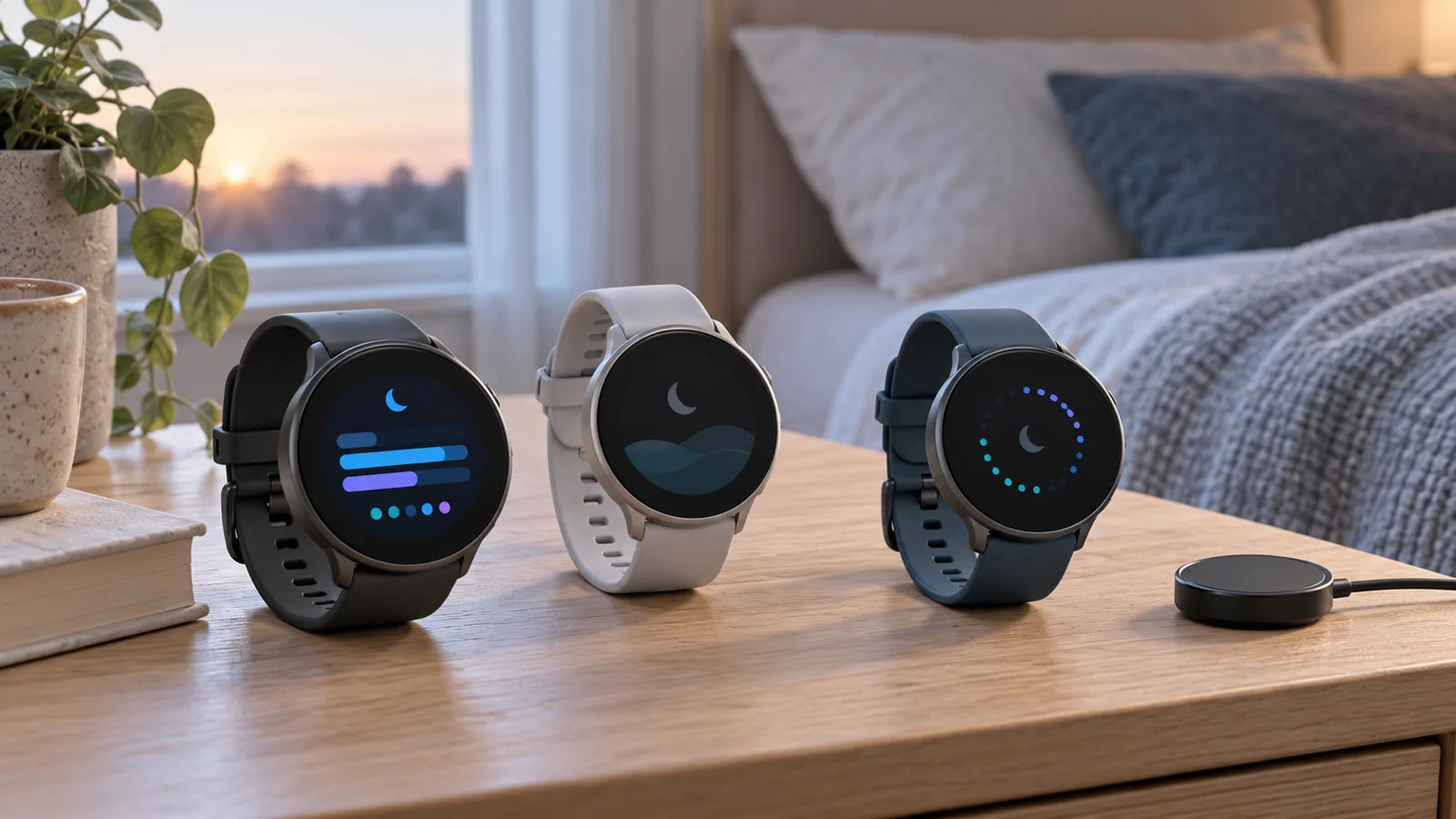
We did not possess, photograph, sleep in, charge-cycle, or compare these watches. The hero image is an original AI-generated generic editorial scene, not product photography. Manufacturer battery claims were not normalized. Apps, algorithms, firmware, services, prices, stock, and policies may change after October 26, 2026.
Independent reviews reflect specific units, sizes, settings, and users. Published studies often cover older devices, small samples, or controlled nights. Their findings do not transfer automatically to a new model. Persistent sleep difficulty, breathing concerns, unusual daytime sleepiness, or other health concerns need qualified evaluation, not another wearable score.
Frequently asked questions
Which sleep tracker watch is best for most people?
The best watch is the one that fits your phone and survives the night. Choose Series 12 for iPhone, Pixel Watch 5 45mm for general Android use, Galaxy Watch9 for Samsung integration, or Venu 4 45mm when multi-day battery matters most.
Should I turn off the always-on display at night?
Yes, if the screen is unnecessary and battery margin is tight. Apple, Google, and Samsung offer sleep or bedtime modes that reduce interruptions. Test one setting change for several nights, since the savings depend on the watch and your other enabled sensors.
Can a smartwatch diagnose sleep apnea?
No. A regulated notification can flag possible risk in its intended population, but it does not establish or rule out a diagnosis. Save a concerning report and discuss it with a qualified clinician.
How many nights should I use before deciding?
Seven ordinary nights can expose comfort, missing data, and charging friction. Some personalized features need longer, including Garmin sleep alignment. Do not miss the seller's return deadline while waiting for an algorithm to settle.
Sources
- Apple: Series 12 size, weight, sleep features, battery, charging, durability, and compatibility
- Apple: US return and refund policy
- Apple: US limited warranty
- Google: Pixel Watch 5 sizes, weight, battery, charging, compatibility, and warranty
- Google Store: US return policy
- Samsung: Galaxy Watch9 price, sizes, battery capacity, sleep features, and requirements
- Samsung: US return policy
- Samsung: US wearable warranty
- Garmin: Venu 4 battery, sizes, compatibility, sleep features, and MSRP
- Garmin manual: Venu 4 battery mode estimates
- Garmin: consumer limited warranty
- Garmin: US shipping and return terms
- Garmin: vivoactive 5 product page and model variants
- WIRED: independent Series 12 day-and-night review
- WIRED: independent Pixel Watch 5 battery and sleep-feature review
- WIRED: independent Galaxy Watch9 battery and charge observations
- Wareable: independent Venu 4 sleep and battery observations
- Journal of Clinical Sleep Medicine: meta-analysis of consumer wrist trackers versus polysomnography
- Sensors: Oura Gen 3, Fitbit Sense 2, and Apple Watch Series 8 compared with polysomnography
- Sleep Health: multicenter validation of 11 consumer sleep trackers
Before you buy
- Confirm phone support and which sleep insights remain free.
- Judge the exact case and band through several full nights.
- Log real overnight battery drain with your chosen sensors enabled.
- Save the seller's return deadline, warranty, and replacement charger cost.
- Use trends as context, not diagnosis or treatment advice.