Best Lumbar Support Pillows and Cushions (2026)
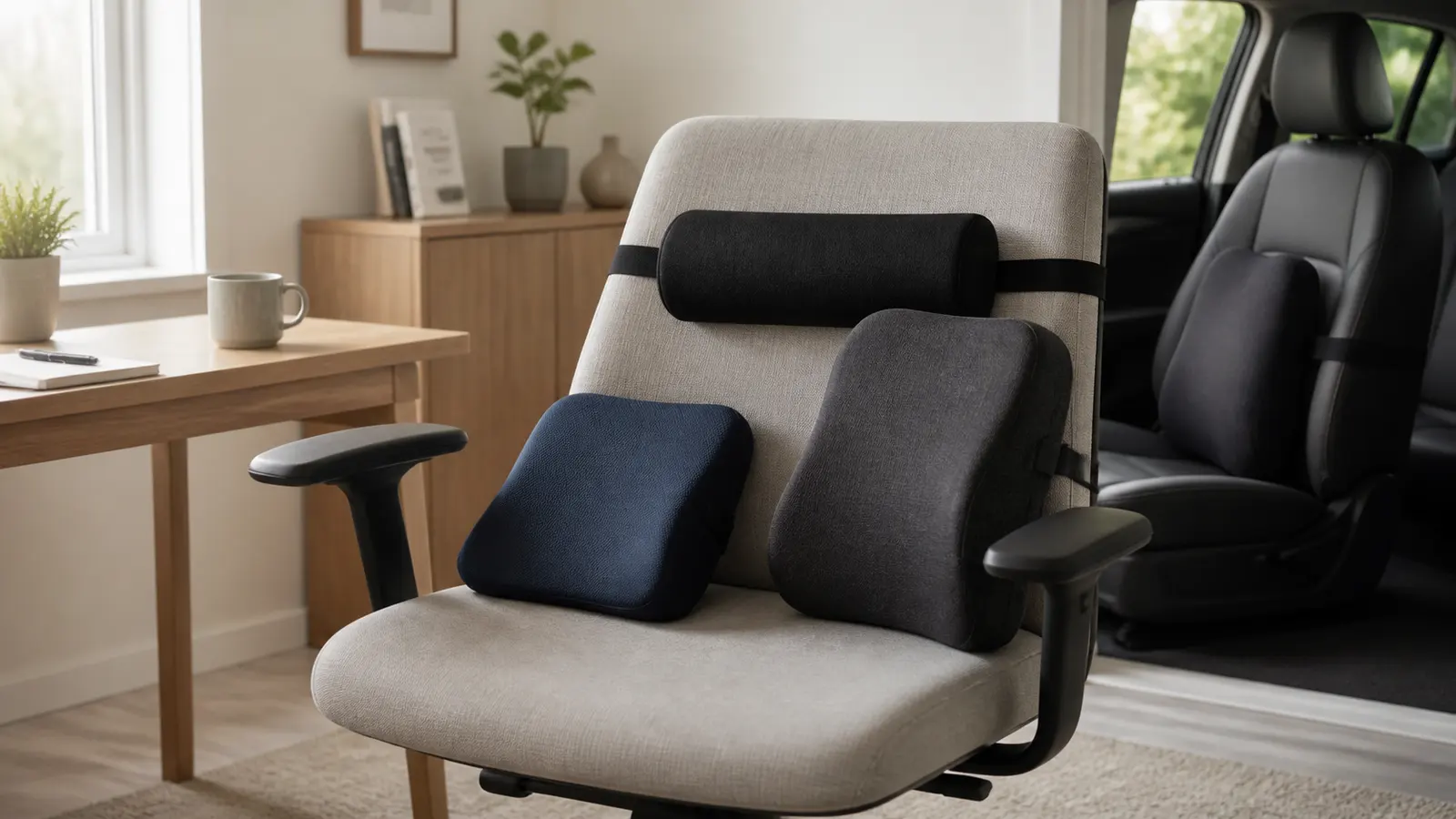
Disclosure: This researched guide links to manufacturers, workplace guidance, research abstracts, and an independent publication. No affiliate links were added. MedHelperPro did not receive, own, sit against, compress, heat-test, or wash these cushions.
Start with curve placement and seat depth, not the thickest pillow.
Cushion Lab Back Relief is the best broad office-chair pick for many average and taller torsos. OPTP Original McKenzie is the budget choice with the most deliberate height placement. Core Slimrest suits shallow seats and shorter torsos. Purple Back Cushion is the breathable option. Tempur-Pedic LumbarCushion offers dense, full-height support, but its direct no-return policy makes it the hardest blind buy.
BACK RELIEF
A lumbar pillow should fill the gap at the inward curve of the lower back without pushing the whole torso toward the front edge of the seat. That sounds simple. It is not. The same four-inch cushion can meet an average torso well, land too high on a shorter torso, and barely reach the curve of a taller person once the chair reclines.
The cushion cannot repair a seat that is too deep, a backrest that misses the body, or a desk that forces the user forward. OSHA's workstation purchasing guide prioritizes adjustable seat depth and a backrest whose lumbar support matches the user's lower-back curve. If several chair dimensions already fail, compare a properly adjustable model in the office chair guide before adding more foam.
Which lumbar support pillow should you buy?
| Pick | Shape and size | Attachment | Firmness or material | Office and car fit | Price and terms checked Aug. 5 |
|---|---|---|---|---|---|
| Cushion Lab Back Relief | Broad contour; 16 by 16 by 4 in | Adjustable gel-lined strap | Dense HyperFoam memory foam | Best on a deep enough office seat; maker also lists cars and sofas | $69 sale price; 30-day like-new return; 1-year limited warranty |
| OPTP Original McKenzie Roll | Cylinder; 4.75 in diameter by 11 in | 1.5 in adjustable elastic strap | Standard or firm polyurethane foam | Easy to move vertically; office, travel, and vehicle use | About $28 at a major retailer; 30-day unused return; defect guarantee |
| Core Slimrest Standard | Low profile; 13 by 12 by 2.75 in | 60 in buckle strap | Polyurethane foam | Good candidate for shallow seats, shorter torsos, cars, and wheelchairs | $46.13 sale price; 90-day satisfaction policy |
| Purple Back Cushion | Low rectangle; product page says 15.75 by 9.25 by 2.5 in | Strap and buckle | Elastic GelFlex Grid | Useful when foam feels warm; do not store in a hot car | $79; 30-day clean return; 1-year warranty |
| Tempur-Pedic LumbarCushion | Full-height contour; 15 by 15 by 4 in | No strap listed | Proprietary Tempur material | Stable office chairs with enough depth; poor fit for frequent transfers | $89; no direct returns; 3-year limited warranty |
Price note: Direct prices are US snapshots from August 5, 2026 and can change. OPTP's maker page did not show a consumer price during this review, so the roughly $28 figure comes from a current major-publication retailer link. Stock, colors, and seller return terms were not assumed.
How were these lumbar cushions selected?
The shortlist covers five genuinely different choices: a broad contoured pillow, a cylindrical roll, a slim wedge, an elastic grid, and a dense full-height cushion. Published dimensions, attachment design, care, current ownership terms, and the chance of preserving usable seat depth mattered more than claims about perfect posture or pain relief.
Good Housekeeping's lumbar pillow comparison was used as an independent cross-check. Its testers represented different ages and work routines and reported on comfort, setup, support, quality, and breathability. Their findings were not converted into MedHelperPro ratings or personal experience.
- Curve placement: A useful support needs enough vertical freedom to meet a particular torso, not merely a pronounced center ridge.
- Seat-depth cost: Thickness has a price. A four-inch cushion can remove precious thigh support from a shallow chair or car seat.
- Attachment: Strap length, buckle type, elasticity, and the chair's back shape determine whether the cushion stays where it was placed.
- Firmness choice: The foam must retain enough shape to fill a gap without becoming a pressure point. There is no universal best firmness.
- Ownership: Removable covers, cleaning instructions, direct return conditions, warranty scope, and heat restrictions can decide the better buy.
Why is Cushion Lab Back Relief the best overall?
Cushion Lab Back Relief makes sense when an office chair needs broad contact rather than one concentrated roll. Its 16-inch-square face is four inches thick at the deepest point. The maker lists dense HyperFoam memory foam, a washable recycled-polyester cover, a gel-lined strap, and CertiPUR-US certification. That certification covers flexible foam emissions, content, and durability, not ergonomic fit or medical outcomes.
The same broad, thick shape is its chief risk. A shorter torso may meet the upper wings instead of the intended curve. A shallow seat may lose too much depth once four inches of foam sit behind the body. The direct price was $69, reduced from $79. The 30-day return policy requires a like-new item and original packaging; the buyer pays return shipping, and original shipping is not refunded. The limited warranty lasts one year.
Best for: average or taller torsos, deep enough office seats, and buyers who want broad contact. Skip it if: the seat is shallow, the backrest is strongly curved, or the upper contour reaches the ribs before the lower section fills the lumbar gap.
Is the OPTP Original McKenzie Roll the best budget pick?
Yes, for buyers who want precise placement. The Original McKenzie Roll is an 11-inch cylinder with a 4.75-inch diameter that slides up or down. OPTP offers standard and firm polyurethane-foam versions, a washable polyester cover, and a 1.5-inch adjustable elastic strap.
Neither firmness label predicts comfort. The roll can feel assertive against a flat backrest and milder against a reclined seat. Its narrow contact band may suit a shorter torso but disappoint someone who wants broad support.
The maker lists office, classroom, car, truck, plane, and stadium use. Its return policy allows returns within 30 days, but products must be in excellent, unused condition for full credit and shipping is generally not refunded. Good Housekeeping's current page showed the roll at about $28 through a major retailer; verify the final seller and terms at checkout.
Best for: tight budgets, shorter torsos, and chairs where vertical placement matters more than wide coverage. Skip it if: concentrated pressure is distracting, the 4.75-inch diameter takes too much seat depth, or the elastic strap cannot grip the chair's back.
Who should choose Core Slimrest Standard?
Core Slimrest Standard is the low-profile option. At 13 by 12 by 2.75 inches, it takes less depth than the full-height cushions. Its 60-inch webbing strap buckles around broad office and vehicle seats without relying on elastic tension. Core lists polyurethane foam, a polyester-and-cotton cover, latex-free construction, a 0.60-pound weight, and US manufacturing. It is a sensible starting point for a shorter torso or shallow seat.
Cleaning is less convenient. Core says to wipe the surface with a damp cloth and mild soap, not remove the cover or soak the foam. The direct sale price was $46.13. Core's company policy advertises a 90-day satisfaction window for replacement or refund, but buyers should confirm how it applies to the exact direct order before use.
Best for: shallow seats, smaller frames, mobility chairs, and restrained car-seat depth. Skip it if: the lower back needs a pronounced fill or a removable machine-washable cover is essential.
Is Purple Back Cushion worth it for warm seats?
Purple swaps solid foam for its elastic GelFlex Grid. Its open channels give air a clearer path than solid memory foam, and Good Housekeeping's testing described it as breathable and cushy. Purple includes a buckle strap, machine-washable cover, and hand-washable core.
Purple's specifications conflict. The product page lists 15.75 by 9.25 by 2.5 inches and 2.5 pounds, while the category FAQ lists 14 by 9 by 2 inches. MedHelperPro could not resolve which size matches every current SKU. Ask Purple before ordering.
The direct price was $79, with a 30-day trial for a clean, undamaged product and a one-year warranty. Purple also warns that extreme heat can warp its cushions and void the warranty. That matters in a parked car, even though the product page mentions transportation.
Best for: office users who dislike the warmth of solid foam and want a lower rectangle. Skip it if: the cushion will live in a hot vehicle, the 2.5-pound weight is awkward to carry, or the unresolved size discrepancy affects fit.
Who should buy the Tempur-Pedic LumbarCushion?
Tempur-Pedic's LumbarCushion measures 15 by 15 by 4 inches, uses proprietary Tempur material, and has a washable navy cover. No strap is listed. That may work on a stable fabric chair, but a loose cushion can need repositioning on slick backrests or during frequent standing. It costs $89.
The direct purchase terms are unusually strict: Tempur-Pedic labels cushions personal items and does not accept returns. Its three-year limited warranty addresses covered defects such as cracking, splitting, or material that fails to return to shape, not a bad comfort fit. A retailer's separate policy may differ.
Best for: buyers who already know they like dense Tempur material and can try the shape first. Skip it if: this is a blind online fit decision, the chair needs a strap, or four inches would leave too little usable seat.
How do torso height and chair depth change the fit?
The Canadian Centre for Occupational Health and Safety advises that the backrest should adjust vertically and front to back, with firm lumbar support that does not create pressure points. NIOSH adds that an ordinary chair can use an attached pad or rolled towel to support the lower back. A rolled towel is a useful no-cost size check before committing to a fixed contour.
| Starting situation | Likely first shape to try | What can go wrong | Pass condition |
|---|---|---|---|
| Shorter torso or shallow seat | Slimrest or vertically adjustable roll | Tall wings press the ribs; thick foam removes thigh support | Curve is supported without moving the body to the seat edge |
| Average torso and typical task chair | Broad contour or roll | Maker's curve sits above or below the user's natural gap | Back reaches the support while shoulders stay relaxed |
| Taller torso or deep seat | Broad full-height cushion | Low roll slips beneath the intended curve | Support can be raised enough and the seat still supports the thighs |
| Vehicle seat | Low profile with secure strap | Cushion shifts, blocks controls, conflicts with seat features, or deforms in heat | Stable fit that follows the vehicle manual and preserves safe control reach |
These are starting hypotheses, not guarantees. The calendar proposed trying short, average, and tall torso heights, but MedHelperPro has no documented test panel or fit measurements. No ranking above is presented as a completed torso test.
A practical fit check before the return window closes
- Fix the chair first. Place the feet on the floor or a stable footrest, sit fully back, and adjust seat height, depth, and recline before adding the cushion. The workspace setup guide puts these purchases in order.
- Find the gap. Roll a small towel and move it vertically until it fills the inward lower-back curve without lifting the ribs or pressing the pelvis forward. Record the towel diameter and position.
- Measure the seat loss. With the cushion in place, check that the seat still supports most of the thighs without pressing behind the knees. If the body slides forward, the cushion is too thick or the chair is too deep.
- Check the attachment. Make sure the strap does not drag the support down, crush a soft mesh back, interfere with seat controls, or sit where the vehicle manual prohibits accessories.
- Use ordinary tasks. Try typing, reading, calls, reclining, and standing up. A cushion that needs constant repositioning has failed even if the first five minutes feel pleasant.
- Keep the packaging. Stop if pressure, numbness, tingling, or pain worsens. Note the return deadline, condition rules, and shipping cost before the product shows wear.
For a car, check the exact vehicle owner's manual. Seat-mounted airbags, heating elements, controls, head restraints, and sculpted bolsters vary. A maker's generic "car use" label cannot confirm compatibility with a specific seat.
Can lumbar pillows relieve back pain?
A pillow can change sitting posture and pressure. That is not the same as treating pain. A small 2013 study of 28 men found that a lumbar support pillow moved lumbar posture modestly closer to neutral during a 30-minute sitting session. It also changed the thoracolumbar region, and subjective comfort did not improve even though an objective comfort measure did.
A 2025 study of 30 people with neck symptoms found posture changes during a 60-minute typing task with a lumbar roll, but little effect on reported discomfort or muscle load. These brief, small studies do not establish long-term pain relief, a best product, or the right shape for a particular body.
Persistent symptoms deserve more than another accessory. Mayo Clinic advises medical evaluation when back pain lasts for weeks, is severe at rest, travels down a leg, or comes with weakness, numbness, or tingling. New bowel or bladder problems, fever, or pain after a fall or injury need prompt care.
Limitations of this researched guide
MedHelperPro did not receive product samples, compare compression, measure pressure, record surface temperature, wash covers, test strap slippage, or observe these cushions in office chairs and vehicles. The calendar proposed testing short, average, and tall torso heights because curve placement is body-dependent. That test was omitted because the repository contains no cushions, participant measurements, consent records, standardized chairs, vehicle log, repeated observations, photos, or dated protocol.
Specifications, prices, availability signals, warranty terms, and return policies were checked on August 5, 2026. They can change by seller, color, region, and SKU. Manufacturer material and comfort descriptions are attributed to their makers. The Purple size conflict is disclosed rather than guessed away. No product score, treatment effect, or hands-on experience is implied.
Frequently asked questions
Where should a lumbar support pillow sit?
It should fill the inward curve of the lower back while the pelvis and upper back remain supported by the seat. It should not act like a shelf beneath the ribs or push the whole body forward. A rolled towel makes a useful placement test before buying a fixed contour.
Is a lumbar roll better than a contoured pillow?
A roll is easier to move up and down and usually costs less. A contoured pillow spreads contact across a larger area and may resist twisting. The better choice is the one that meets the user's curve without taking too much seat depth or becoming a pressure point.
Can the same lumbar cushion work in an office chair and a car?
Sometimes, but chair and vehicle geometry differ. A car cushion needs stable placement, enough clearance for controls and safe reach, and compatibility with the vehicle manual. Heat storage also matters. Check each seat separately instead of treating a maker's generic vehicle claim as a fit guarantee.
Should a lumbar support pillow feel firm?
It needs enough structure to fill the gap, but harder is not automatically better. Return a pillow that creates a localized pressure point, pushes the ribs forward, or makes the user perch at the seat edge. OPTP offers standard and firm versions for buyers who want an explicit choice.
Sources checked August 5, 2026
- OSHA computer workstation purchasing guide
- NIOSH work-from-home workstation guidance
- Canadian Centre for Occupational Health and Safety chair guidance
- 2013 lumbar support pillow sitting study abstract
- 2025 lumbar roll typing study abstract
- CertiPUR-US certification scope and frequently asked questions
- Mayo Clinic back-pain care guidance
- Cushion Lab Back Relief product page and return policy
- OPTP Original McKenzie Roll product page and return policy
- Core Slimrest Standard product page and satisfaction policy
- Purple Back Cushion product page, category details, and return policy
- Tempur-Pedic LumbarCushion product page and limited warranty
- Good Housekeeping lumbar support pillow testing and comparison
Before you buy: Set up the chair first, measure usable seat depth and backrest circumference, test curve position with a rolled towel, and confirm the exact price, dimensions, return condition, warranty, cleaning instructions, and vehicle compatibility. Keep packaging until normal work confirms the fit.