Best Footrests for Under a Desk: 5 Smart Picks (2026)
Disclosure: This researched guide compares current manufacturer specifications, return and warranty terms, recognized workplace guidance, and independent coverage. No affiliate links were added. MedHelperPro did not receive, own, measure, or use these footrests.
Measure the floor gap before choosing a footrest.
UPLIFT Elevate is the best overall researched pick because its six height positions cover far more fit situations than a fixed block, while the removable platform reaches unusually low. Humanscale FR500 is the strongest simple rocker. ErgoFoam is the softer two-height choice. IKEA OVNING is the budget and portable pick. Secretlab Professional Footrest is the premium option when a lockable angle matters.
ELEVATE
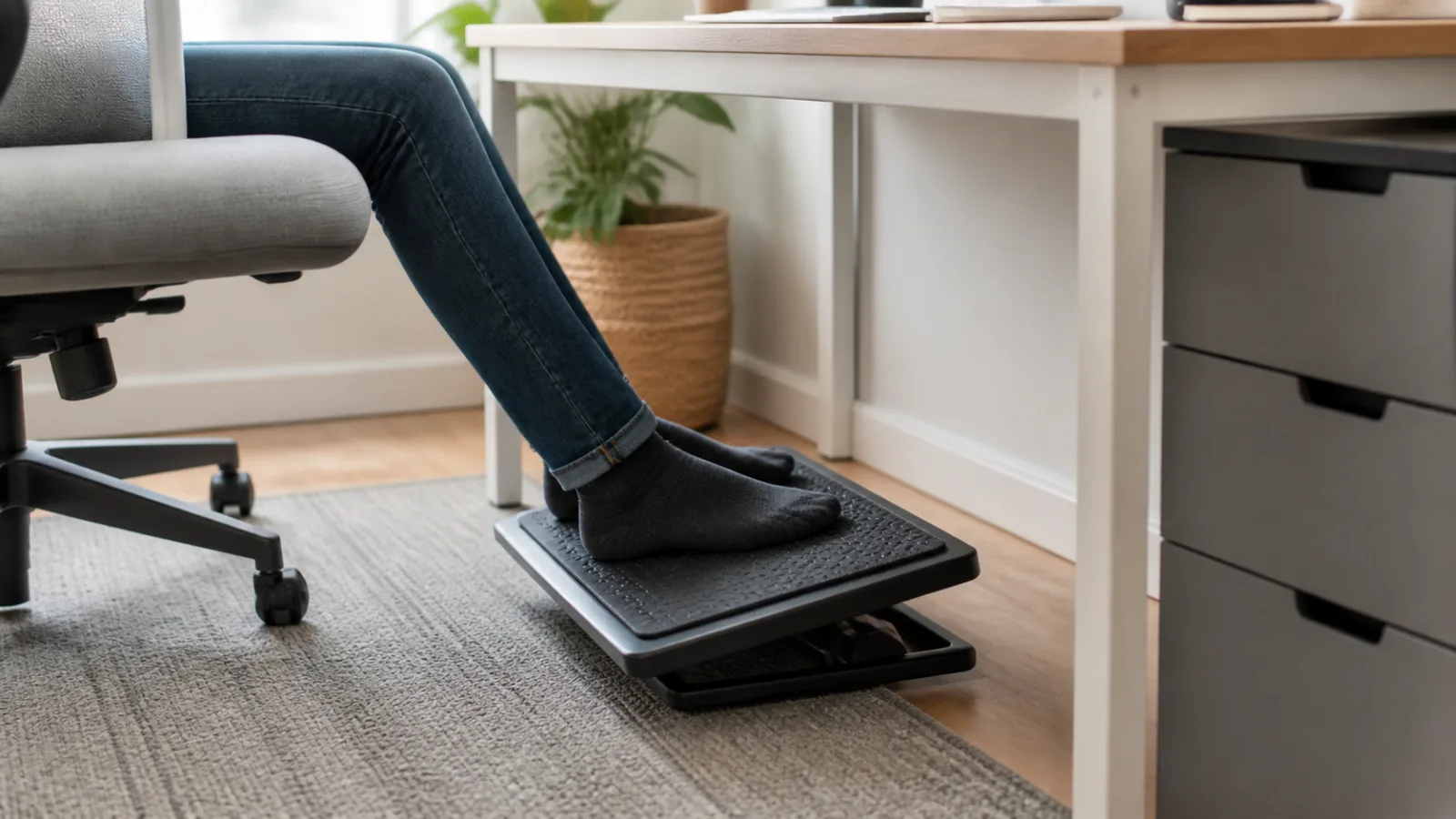
A footrest is useful when your chair has to stay high enough for the keyboard but your feet no longer rest firmly on the floor. The OSHA computer-workstation guidance says feet should be fully supported by the floor or a footrest. Its chair guidance adds an important qualifier: use a stable footrest if lowering the chair would put the keyboard or monitor too high.
That order matters. Set the chair for the desk first, then measure the empty space beneath your feet. Do not buy from standing height alone. Two people who are 5 feet 2 inches tall can need different lift because chair height, lower-leg length, footwear, desk thickness, and keyboard position all change the gap. The same is true for two people who are 5 feet 10 inches tall.
If several parts of the workstation need attention, start with the complete ergonomic workspace guide. A footrest can support the feet, but it cannot correct an overly deep chair, a high keyboard, or a monitor that forces the neck downward. Shorter users should check the low-seat and shallow-depth office-chair comparison before using a footrest to compensate for the wrong chair.
Which under-desk footrest should you buy?
| Pick | Lift and angle | Surface and portability | Best for | Price and ownership checked Aug. 11 |
|---|---|---|---|---|
| UPLIFT Elevate Best overall | Six positions from 3.5 to 8.5 in at front edge; fixed 12 degree incline; platform removes for low-profile use | Felt-covered steel platform and steel frame; built-in handle | Broadest height-fit range and shared workstations | $59; 30-day free returns in contiguous US; 15-year warranty |
| Humanscale FR500 Best simple rocker | 4.5 in high; curved base rocks continuously; no height adjustment | Hardwood platform, steel frame, grip surface; 7 lb | People who want smooth movement and a durable hard surface | $127.50 promotional price, regularly $150; 30-day return terms; 15-year warranty |
| ErgoFoam Adjustable Best soft option | 3.9 or 5.9 in high; flips into a rocker | High-density foam, washable cover, non-slip bottom; light enough to move easily | Socked feet, shorter users who need extra lift, and soft-surface fans | $44.67 listed; limited lifetime warranty; verify seller return terms before ordering |
| IKEA OVNING Best budget and portable pick | 7 1/8 in high; curved shape rocks; no height or angle lock | Polyethylene foam, washable polyester cover, anti-slip underside; 1 lb 5 oz packaged | High lift on a small budget and moving between rooms | $19.99; IKEA lists 365 days unopened or 180 days opened with proof of purchase |
| Secretlab Professional Footrest Best lockable rocker | 4.3 in high; dynamic 30 degree range; locks from +15 to -15 degrees | Full-metal chassis, magnetic memory-foam top; 21.8 by 13.7 in footprint | Users who switch between free rocking and a held angle | $199 in the current brand guide; up to 49-day returns with fees; verify accessory warranty |
Price note: These are direct US price snapshots from August 11, 2026. Sales, stock, shipping, tax, regional policies, and configurations can change. The prices and specifications are manufacturer claims unless an independent source is identified.
How were these footrests selected?
The shortlist covers five distinct buying decisions. We checked current product pages, specifications, and ownership terms. Guidance from OSHA, CCOHS, and NIOSH shaped the fit criteria. ISO 9241-5:2024 supplies current international principles for workstation layout and posture, but no standard guarantees personal comfort.
Consumer Reports evaluated ten footrests with an ergonomics specialist. Its work helped cross-check size, movement, stability, and surface. MedHelperPro did not copy its scores or testing claims.
- Fit range: We favored a published lift range or a clearly stated height. A vague "ergonomic" label did not count.
- Foot support: The surface must plausibly support both feet without forcing a narrow stance. The CCOHS chair-adjustment guide says a footrest should support both feet and keep them flat and firm.
- Movement choice: Rocking can make position changes easy, but some users need a stable platform. Locking or fixed behavior is a real design distinction.
- Surface: Hard felt, hardwood, and foam feel different with shoes or socks and demand different cleaning.
- Ownership: Returns matter because lift and pressure are personal. We also checked warranties, size, weight, and maintenance where terms were visible.
Why is UPLIFT Elevate the best overall?
UPLIFT Elevate solves the most common fit problem in this category: not knowing the exact lift you need until the chair and desk are set. UPLIFT lists six tool-free positions, measured at the front edge of the platform, from 3.5 to 8.5 inches. The platform itself has a fixed 12 degree incline. It can also be removed and placed directly on the floor for lower-profile support.
The range suits shared desks and users who need substantial lift. A powder-coated steel frame avoids foam compression, while non-slip felt covers the platform. Rubber bumpers protect the floor, and a handle helps with carrying. Changing height requires repositioning the platform, so adjustments happen between work sessions.
UPLIFT lists a 15-year warranty. Its current return policy offers 30-day free returns with free return shipping in the contiguous United States when the item comes back in like-new condition and original packaging. Keep the box until the fit is settled.
Best for: uncertain fit, shared desks, and users who need more than a token lift. Skip it if: you want continuous rocking, a cushioned surface, or height adjustment without getting out of the chair.
Who should choose the Humanscale FR500?
Humanscale FR500 is the cleanest rocker here. Its curved frame lets the hardwood platform move with the ankles, and the grip surface helps shoes stay put. Humanscale lists a 4.5-inch height, 16.75-inch width, 12.25-inch depth, and 7-pound weight. There are no levers or height layers.
The platform is sturdy and easy to reposition, but 4.5 inches either matches the gap or it does not. Anyone who wants one fixed angle may dislike the constant rocking.
The direct US store showed a promotional $127.50 price, down from $150. Humanscale describes a 30-day satisfaction window for products returned in resaleable condition with proof of purchase. The FR500 carries a 15-year warranty. Check the regional policy because the store routes terms by location.
Best for: shoes, a firm platform, and frequent ankle movement. Skip it if: you need adjustable height, a locked angle, soft cushioning, or a budget pick.
Is ErgoFoam Adjustable the best soft footrest?
ErgoFoam Adjustable suits users who already like foam. Removing the lower layer changes the published height from 5.9 to 3.9 inches. The whole unit flips to rock, the cover is washable, and the bottom is non-slip.
Independent context is useful here. A GameSpot reviewer used an ErgoFoam footrest for a month and confirmed the roughly four-inch and six-inch configurations, soft feel, washable cover, and flip-to-rock design. That is one reviewer's experience, not MedHelperPro testing or proof of long-term foam durability.
The direct page listed $44.67 and a limited lifetime replacement warranty for defects. A change-of-mind policy was not clearly surfaced, so verify the seller's return window. Foam also compresses, making its support height less exact than steel.
Best for: socked feet, users choosing between about four and six inches of lift, and anyone who dislikes a hard platform. Skip it if: you wear dirty outdoor shoes at the desk, need exact height, want a locked tilt, or prefer a surface that will not compress.
Is IKEA OVNING a good budget footrest for adults?
Yes, for the right adult. IKEA places OVNING in its children's range but says teens and adults can use it. The polyethylene-foam body is 15 inches wide, 12 5/8 inches deep, and 7 1/8 inches high. The cover is machine washable, and the packaged weight is 1 pound 5 ounces.
The high lift and low weight suit a shorter user moving between work areas. It is not adjustable, and seven inches is too high for many setups. The 15-inch width can also confine a wide stance. Measure knee clearance before assuming more lift is better.
IKEA listed OVNING at $19.99. Its US return policy lists 365 days for unopened products and 180 days for opened products with proof of purchase, subject to condition and exclusions. No special long warranty appears on the product page.
Best for: high lift, small budgets, lightweight portability, and easy cover washing. Skip it if: your measured gap is under seven inches, you need a broad platform, or you want to lock the rocking angle.
When is Secretlab Professional Footrest worth $199?
Secretlab Professional Footrest is the premium pick for one specific feature: switching between a free-moving platform and a fixed angle. Dynamic mode gives a 30 degree movement range. Stationary mode locks the platform at any angle from 15 degrees forward to 15 degrees back. The full-metal chassis measures 21.8 by 13.7 by 4.3 inches, and the magnetic CloudSwap top can be replaced with other compatible surfaces.
The broad platform and lock suit someone who wants motion during one task and stable support during another. The 4.3-inch base height is fixed. Secretlab sells an extender for users under 4 feet 10 inches and warns against placing the base on porous surfaces such as painted floors and concrete.
Secretlab's current brand guide listed $199. The US site advertises up to 49-day returns with fees on comparable accessories and routes buyers to product-specific terms. The product page did not clearly show the accessory warranty length. Confirm both at checkout instead of assuming the chair warranty applies.
Best for: a large platform, premium materials, and choosing between rocking and a held angle. Skip it if: you need adjustable lift, easy portability, a simple return, or a footrest that costs less than the chair accessory budget.
How should a 5'2" and 5'10" user choose differently?
The calendar proposed a side-by-side comparison with users who are 5 feet 2 inches and 5 feet 10 inches. MedHelperPro did not perform it because no participant log, measurements, photos, or product samples exist. Published dimensions cannot predict comfort from height alone.
A 5-foot-2 user is more likely to need lift after raising a chair to reach a fixed desk. Start with the measured heel-to-floor gap. Elevate covers 3.5 to 8.5 inches, ErgoFoam covers about 3.9 or 5.9 inches, and OVNING provides a fixed 7 1/8 inches. The shorter user should also check that the raised knees do not contact a drawer or desk apron.
A 5-foot-10 user may need little or no lift if the chair already allows flat feet and a comfortable keyboard position. If a footrest still helps with position changes, the 4.3-inch Secretlab or 4.5-inch Humanscale can work, but only when that lift does not push the knees above a comfortable level. UPLIFT's low-profile configuration offers more room to tune down.
For either person, the test is the same: can the entire sole rest without pressure behind the knees, lifted shoulders, or a reach toward the keyboard? If the answer changes after chair adjustment, fix the chair and desk relationship before blaming the footrest.
Buyer's guide: four checks that prevent a bad fit
1. Set the chair for the keyboard, then measure
Sit back in the chair and set its height so the forearms meet the keyboard without raised shoulders. If the feet float, measure the vertical gap from the floor to the sole at the heel. That number is the starting lift target. NIOSH's work-from-home ergonomics guidance suggests trying a box or stack of books when a footrest is unavailable. That is also a sensible no-cost way to estimate height before buying.
2. Check platform width and surface
Both feet should fit without squeezing the knees together. A 15-inch platform may suit a compact desk, while a wider surface allows more stance changes. Felt and hardwood tolerate shoes better. Foam feels warmer with socks but can compress and collect dirt.
3. Decide whether movement is a feature or a distraction
A rocker gives the ankles something to do and makes small posture shifts natural. It can also move when you want a firm brace. Fixed platforms suit steady foot support. Lockable designs split the difference at a higher price. No choice replaces getting up and changing position. For more ways to alternate sitting, standing, and short breaks, see the desk movement gear guide.
4. Treat the return window as a fit check
Keep every insert and piece of packaging. During the allowed indoor trial, check foot contact, pressure behind the knees, desk clearance, sliding on the actual floor, movement noise, and whether the footrest remains in reach after several normal work tasks. Manufacturer return terms can differ from marketplace terms, so save the policy shown by the seller you actually use.
What can a footrest fix, and what can it not fix?
A footrest fills the gap between feet and floor. It cannot shorten an oversized seat pan, lower a keyboard, or fix a poorly placed backrest. If the chair is the problem, compare office-chair fit and adjustment ranges. If the chair fits but the lower back lacks contact, the lumbar support guide explains when a cushion may help.
A footrest also does not diagnose or treat pain, circulation problems, numbness, or weakness. Persistent or worsening symptoms deserve advice from a qualified clinician. Stop using any setup that increases symptoms. Ergonomic products are tools for fit and support, not medical treatment.
Frequently asked questions
Should a footrest be flat or angled?
Either can work if both feet are supported and the angle feels neutral. A slight fixed incline is predictable. A rocker permits ankle movement. A lockable model is useful when you want both. Avoid an angle that points the toes sharply or increases pressure behind the knees.
How high should an under-desk footrest be?
Approximately the gap beneath your feet after the chair is set for the keyboard. Measure that gap rather than choosing from body height. The final setup should support the full sole without crowding the underside of the desk.
Is a foam or hard footrest better?
Foam is softer, warmer, and lighter. A hard platform provides more exact support height and is usually easier to use with shoes. Neither is universally better. Surface preference, compression, cleaning, and portability make the difference.
Can I use a box instead?
Yes, as a short trial if it is stable, wide enough for both feet, and cannot slide. NIOSH specifically suggests a solid box or books as a home-workstation workaround. A purpose-built footrest becomes more useful when you need grip, a particular angle, rocking, easier cleaning, or a durable height.
Research and testing limitations
MedHelperPro did not physically test these products. No force, compression, slip, surface-temperature, long-term durability, or noise measurements were performed. Product dimensions, prices, materials, warranties, and return policies came from current manufacturer pages and were checked on August 11, 2026. Independent coverage is labeled where used.
The proposed 5-foot-2 and 5-foot-10 side-by-side panel was omitted because no documented participants, samples, dated logs, or measurements were available. The recommendations use published adjustment ranges and a repeatable fit process instead. Comfort and stability still depend on the user's chair, desk, footwear, flooring, and body dimensions.
Sources and further reading
- OSHA: Good Working Positions
- OSHA: Computer Workstation Chairs
- CCOHS: Office Ergonomics, Chair Adjustment
- NIOSH: Working from Home, How to Optimize Your Work Environment and Stay Healthy
- ISO 9241-5:2024, Workstation Layout and Postural Requirements
- Consumer Reports: Best Footrests for a More Comfortable Desk Setup
- UPLIFT Elevate product page
- Humanscale FR500 product page
- ErgoFoam Adjustable product page
- IKEA OVNING product page
- Secretlab Professional Footrest product page
Before you buy: Confirm current price, dimensions, lift, warranty, return terms, and floor compatibility on the seller's site. A footrest should support the full soles without creating pressure behind the knees or crowding the desk.