Best Office Chair for Short People: 5 Picks (2026)
Disclosure: This researched guide compares manufacturer specifications, current prices, warranties, returns, recognized ergonomics guidance, and independent coverage. No affiliate links were added. MedHelperPro did not sit in, measure, assemble, or long-term test these chairs.
Start with minimum seat height and usable seat depth.
Steelcase Leap has the broadest adjustment package in this group and is the best overall match if the price works. Herman Miller Aeron Size A reaches the lowest in its standard configuration. Haworth Breck is the strongest value. Steelcase Series 1 is a practical compact choice, while Herman Miller Sayl fits a small room but starts higher than Aeron Size A.
LEAP
The label "petite" does not tell you whether a chair will fit. People of the same height can have different leg proportions. The useful numbers are minimum seat height, shortest usable seat depth, armrest range, and whether the chair still moves close to the desk.
OSHA's chair guidance says the feet should rest on the floor with the back of the knee slightly higher than the seat, and the pan should support most of the thigh without touching the back of the knee. If the desk forces you to raise a well-fitting chair, use a stable footrest rather than leaving your feet unsupported.
Which office chair fits a shorter person?
| Office chair | Minimum seat height | Shortest seat depth | Best fit | Price and ownership checked Sept. 19 |
|---|---|---|---|---|
| Steelcase Leap | 15.5 in | 15.75 in functional depth | Best overall adjustment range | Premium, direct price not exposed; 400 lb; 12-year warranty; confirm return terms |
| Herman Miller Aeron Size A | 14.75 in on the current store page | 16 in fixed seat depth | Lowest standard seat and breathable mesh | $1,620 to $2,685 by configuration; 300 lb; 12-year warranty; return fee applies |
| Haworth Breck | 15.5 in | 15 in | Best value and shallowest seat | $404 sale, $435 regular; 325 lb; 12-year warranty; free 30-day returns |
| Steelcase Series 1 | 16.5 in standard; 14.75 in optional low range | 15.5 in functional depth | Compact midrange choice | $589 to $599; 300 lb; limited lifetime warranty; free 30-day returns |
| Herman Miller Sayl | 16 in standard; 15 in low-height option | 16 in with depth option | Small rooms and light visual footprint | $885 to $1,530 by configuration; 350 lb; 12-year warranty; return fee applies |
Price note: Direct US prices, availability, and policy terms were checked September 19, 2026. Steelcase's direct Leap page routed to a configurator without exposing a stable price. Optional low-height cylinders and adjustable-depth seats may require a dealer order. Confirm the exact configuration before paying.
What chair dimensions matter most for short people?
Minimum seat height
Seat height determines whether the feet can stay supported without pressure building under the thighs. Measure from the floor to the crease behind your knee while wearing normal work shoes. Use that as a starting point, not a prescription. Cushion compression, footwear, and the chair's front-edge shape all change the final setting.
Aeron Size A has the lowest published standard setting here. Series 1 and Sayl can go lower only with options that may not appear in ordinary online configurations. A listed low of 14.75 inches is useful only if the delivered chair actually includes that cylinder.
Seat depth
A short torso does not always mean short thighs, but deep seats are a common fit problem. CCOHS suggests about a clenched fist, roughly 2 inches, between the seat edge and the calf after the back is supported. Too much depth can make you perch forward. Too little removes useful thigh support.
Breck reaches a published 15-inch seat depth, the shortest in this group. Leap, Series 1, and an appropriately configured Sayl also adjust front to back. Aeron Size A uses a fixed 16-inch frame, so it needs a more careful trial if your proportions fall near a size boundary.
Armrests and desk clearance
Armrests should support the forearms without lifting the shoulders. They also need to clear the desk so you can get close to the keyboard. OSHA's purchasing guide recommends removable armrests with adjustable spacing and height. Leap's broad arm movement helps here; fixed or limited arms can turn an otherwise good seat into a reach problem.
Footrest compatibility
A footrest is a sound fix when the desk is too high and the chair must rise to keep the keyboard near elbow height. It is not a fix for a pan that is too deep, armrests that hit the desk, or a backrest curve that lands in the wrong place. See the footrest comparison for minimum lift, tilt, and under-desk space.
How were these chairs selected?
This shortlist emphasizes published dimensions that affect shorter users. Each chair needed a credible current purchase path, official specifications, seat-height evidence, and a clear reason to choose it. We compared minimum height, minimum depth, arm movement, capacity, warranty, return friction, and compact-room fit.
ANSI/BIFMA X10.1-2024 uses anthropometric data spanning the 5th-percentile woman through the 95th-percentile man, while recognizing individual exceptions. ANSI/BIFMA X5.1 covers general-purpose office-chair safety, durability, and structural performance. A standards claim is useful evidence, but it does not prove that one chair fits your proportions.
Independent coverage was used as a cross-check, not as a score to copy. WIRED's current office-chair guide also points shorter users toward Breck and Sayl, while Tom's Guide highlights Aeron's three-size approach. Product measurements and policy facts in this guide come from official sources.
Why is Steelcase Leap the best overall?
Leap combines a 15.5-inch minimum seat height with functional seat depth from 15.75 to 18.75 inches. That range gives a shorter user room to keep the back against the backrest and reduce pressure behind the knees. The seat is 19.25 inches wide, and the four-dimensional arms can move inward, outward, forward, back, and pivot.
The backrest adds adjustable lumbar height and firmness. Those controls are not automatically comfortable, but they let you reduce an aggressive curve or move it closer to the lower back. The chair carries a 400-pound listed capacity and Steelcase's 12-year multi-shift warranty for the Americas.
The drawbacks are price, an upholstered back that can feel warm, and a heavy chair that is awkward to rebox. The US product page did not expose a stable direct price when checked, so request the complete quote and return terms before ordering. Best for: someone who wants the widest practical tuning range in one standard chair. Skip it if: you want a low-cost chair, strongly prefer mesh, or cannot confirm a workable return path.
Is Aeron Size A the best chair with a very low seat?
Aeron Size A starts at 14.75 inches on the current US store page, lower than the standard configurations of the other four picks. Herman Miller's size chart places Size A around users from 4 feet 10 inches to 5 feet 4 inches, with overlap at the upper end. Its mesh seat and back also suit people who dislike thick foam or run warm.
The tradeoff is a fixed 16-inch seat pan inside a framed mesh edge. You cannot shorten it, and the frame can feel restrictive if you sit cross-legged. Try the exact size if possible. Do not assume Size A is right because of height alone.
Current official pricing ranged from $1,620 to $2,685 depending on options. The chair has a 300-pound capacity and 12-year warranty. Herman Miller's current US return policy accepts performance seating within 30 days, but charges $99 return shipping; losing the original packaging can trigger a 10 percent restocking fee instead. Best for: a buyer who needs the lowest standard seat and prefers mesh. Skip it if: you need adjustable depth, a soft front edge, or a low-cost trial.
Why is Haworth Breck the best value?
Breck publishes a 15.5 to 20.5-inch seat-height range and a 15 to 17.25-inch depth range. That shortest setting beats the other adjustable pans here. The arms span 15.7 to 21.1 inches, so they can move inward for a narrower upper body. Its seat remains a generous 19.5 inches wide.
The current page showed $404, down from $435, with a 325-pound capacity, 12-year warranty, and free returns within 30 days. The chair ships flat and Haworth describes tool-free assembly in under a minute. Keep every packing piece until the seat and arms pass several ordinary workdays.
Breck uses weight-activated recline rather than a manual tension dial. That keeps the controls simple, but it gives a light user less authority over the recline feel than Leap. Best for: shorter buyers who want shallow depth and useful arm movement below premium pricing. Skip it if: you want manual tilt-tension tuning, a headrest, or white-glove delivery.
Who should buy Steelcase Series 1?
Series 1 is the more compact Steelcase route. Its standard cylinder lists a 16.5 to 21.5-inch seat height, which may still be too high. The important detail is an optional low-range cylinder from 14.75 to 17.75 inches. That option is listed in the official specification guide but may require a dealer order rather than the common retail configuration.
Functional seat depth adjusts from 15.5 to 17.75 inches. Four-dimensional arms span roughly 16 to 20 inches, and the authorized retail version lists a 300-pound capacity. West Elm showed $589 to $599 and a free 30-day return for Steelcase chairs in new condition with original packaging.
The back and seat offer less nuanced tuning than Leap, and the standard cylinder weakens the fit for this specific buyer. Best for: someone who wants a compact, midrange chair and can verify the low cylinder before purchase. Skip it if: the seller cannot identify the cylinder or you need the strongest lumbar control.
Does Herman Miller Sayl work for a petite person?
Sayl fits a small room well because the chair is about 24.5 inches wide and its frameless back keeps the visual footprint light. With the depth-adjustable seat option, the pan ranges from 16 to 18 inches. The chair supports up to 350 pounds and carries Herman Miller's 12-year warranty.
The standard seat height starts at 16 inches. A 15 to 19-inch low-height option appears in official product documents, but it is not guaranteed in every online configuration. The direct store showed $885 to $1,530 depending on upholstery and adjustments. Make sure the cart includes adjustable depth, and confirm the cylinder separately.
Sayl's flexible back has no conventional padded lumbar block, which some buyers will appreciate and others will miss. Herman Miller's performance-seating return fees also apply. Best for: a compact home office where design and a flexible back matter. Skip it if: you need a standard sub-16-inch seat, firm lumbar pressure, or an inexpensive return.
How to measure your chair fit before ordering
- Measure lower-leg height. Sit on a firm, level surface with normal work shoes and feet flat. Measure from the floor to the crease behind the knee.
- Estimate usable seat depth. Measure from the back of the buttocks to the back of the knee, then allow roughly 2 inches of clearance as a starting point.
- Measure the desk. Record the floor-to-underside height and the surface height. Include any apron, drawer, or keyboard tray.
- Check arm width. Relax the shoulders and measure the forearm position that keeps the elbows near the body. Confirm the chair can narrow to it.
- Map the chair footprint. Leave room for the base and recline. A narrow back does not mean a narrow five-star base.
Then compare the numbers with the exact configuration, not a category page. If a local showroom has the model, bring the measurements and sit through a normal typing task. A brief showroom impression cannot predict an eight-hour day, but it can reveal obvious depth, edge, and desk-clearance failures.
When does a footrest make more sense than a lower chair?
Use the chair's lower setting when that still lets the elbows stay near keyboard height and the thighs clear the desk. Use a footrest when the fixed desk forces the chair higher. CCOHS chair guidance treats supported feet and workstation fit as part of the same decision.
Do not buy a tall footrest without checking knee clearance. The platform raises the knees and may create contact with a desk apron. If several parts of the setup are wrong, use the ergonomic workspace buying order before replacing everything at once.
Return-window fit checklist
- Keep the box, protective wrap, tags, hardware bags, and a photo of the packing order.
- Set seat height first, then depth, back support, recline, and arms.
- Use the chair at the actual desk for several normal work blocks.
- Check whether both feet stay supported and whether the front edge avoids calf pressure.
- Make sure the back reaches the backrest without you sliding forward.
- Confirm the arms support rather than lift the shoulders and still clear the desk.
- Change position and take movement breaks. A fitted chair does not make stillness harmless.
- Start the return before the deadline if one core dimension cannot be fixed.
If pain is persistent, severe, worsening, or accompanied by numbness or weakness, seek advice from a qualified health professional. A chair is not a diagnosis or treatment. The office-chair guide for back pain explains why adjustment and return terms matter more than therapeutic marketing.
Frequently asked questions
What seat height works for someone who is 5 feet 2 inches?
There is no reliable height-only answer because lower-leg proportions and shoes vary. Measure from the floor to the crease behind the knee while seated, then choose a chair that can adjust around that number. Aeron Size A has the lowest standard setting here at 14.75 inches.
Can a footrest fix an office chair that is too tall?
It can support the feet when a high desk requires a raised chair. It cannot shorten a deep seat, move the lumbar curve, narrow the arms, or create knee clearance. Treat it as part of a fitted workstation, not a universal patch.
Is Aeron Size A better than Steelcase Leap for a short person?
Aeron Size A reaches lower and has a breathable mesh seat, but its 16-inch depth is fixed. Leap starts slightly higher and has upholstery, but its depth, lumbar support, and arms offer more tuning. Your lower-leg height, thigh length, desk, and material preference decide the better fit.
Should I buy a used premium office chair?
Used can reduce the price, but inspect the cylinder, tilt, arm movement, seat edge, mesh or foam, and replacement-part availability. Manufacturer warranties may not transfer. A refurbished chair is more attractive when the seller states which parts were replaced and offers a real return window.
Research and testing limitations
MedHelperPro did not physically measure or use these chairs. No seat-height tape readings, seat-depth measurements, assembly timing, pressure mapping, comfort logs, sound readings, recline-force tests, or long-term durability observations were performed. Specifications, prices, stock, warranty terms, and return rules were checked September 19, 2026.
The editorial calendar proposed actual tape-measure readings against shorter-user guidelines. The repository contains no chair samples, measurement photos, calibration notes, or dated observations. Publishing those readings as completed would invent evidence. This guide uses manufacturer specifications, clearly identifies optional configurations, and gives readers a repeatable measurement process instead.
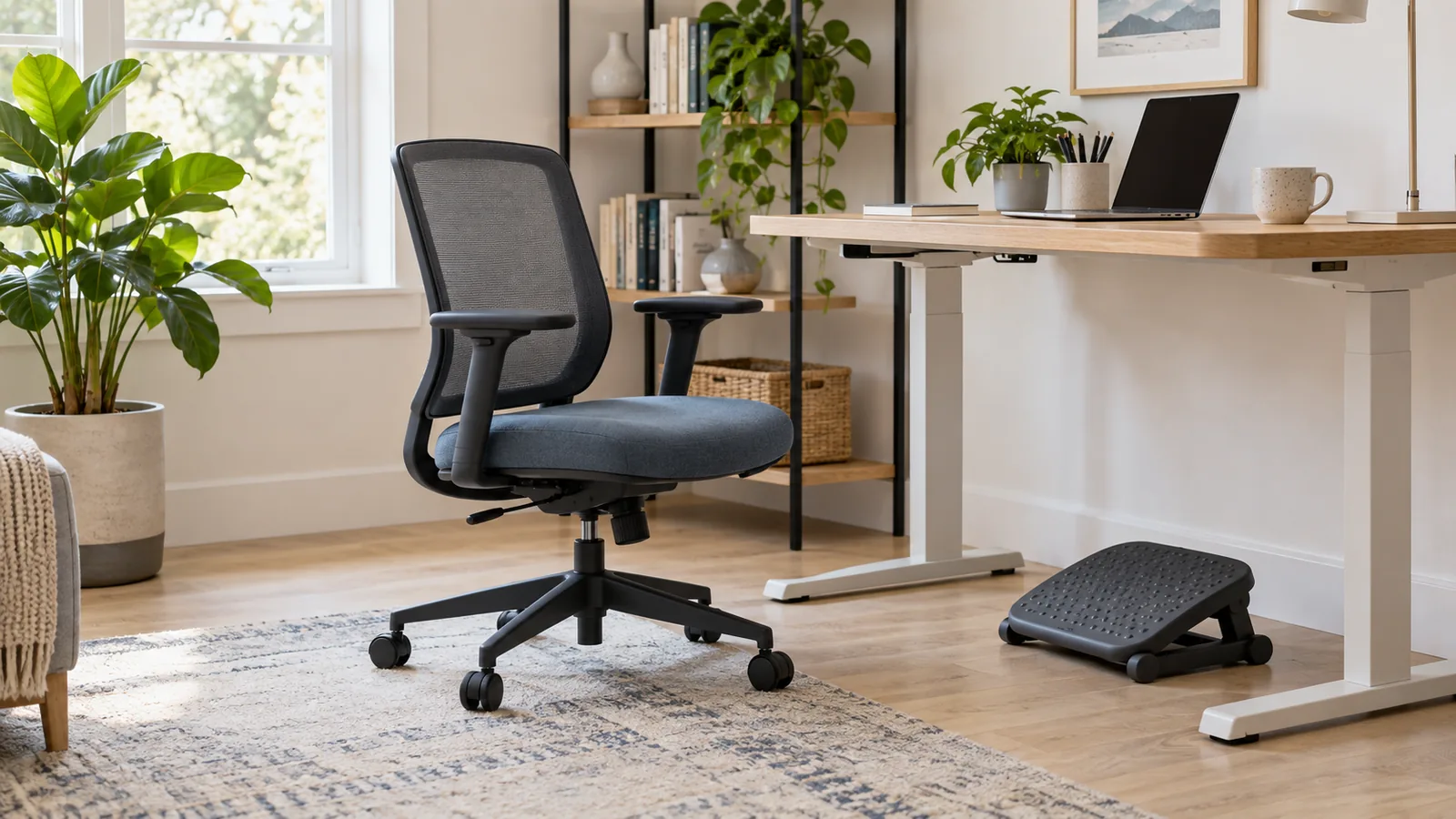
The original hero is a generated, generic editorial home-office scene. It is not a photograph of a MedHelperPro test space and does not depict any named chair.
Sources and further reading
- OSHA: chair fit, seat height, seat pan, backrest, and foot support
- OSHA: computer-workstation purchasing guide
- CCOHS: selecting an office chair
- CCOHS: adjusting seat depth, height, backrest, and arms
- BIFMA: X10.1-2024 furniture dimensions and adjustment ranges
- BIFMA: office-chair safety and durability standards
- Steelcase: Leap product details and official specification guide
- Herman Miller: Aeron specifications and size chart, current store configuration, and returns
- Haworth: Breck price, dimensions, warranty, and returns and official product sheet
- Steelcase: Series 1 product details, official specification guide, and current authorized retail terms
- Herman Miller: Sayl dimensions and options and current US price and configuration
- WIRED: independent office-chair coverage
- Tom's Guide: independent office-chair testing and size comparison
Before you buy: Recheck the exact seat-height range, seat-depth option, cylinder, arm type, capacity, current price, stock, delivery, warranty, return deadline, packaging requirements, and fees on the seller's site. This guide is product research, not a hands-on comfort or fit test.