Best Office Chair for Tall People: 6 Picks (2026)
Disclosure: This researched guide compares manufacturer specifications, current prices, warranties, returns, recognized ergonomics guidance, and independent coverage. No affiliate links were added. MedHelperPro did not sit in, measure, assemble, or long-term test these chairs.
Start with leg support, then check where the back and headrest land.
Oak Hollow Aloria with the tall cylinder is the strongest match for long legs because it reaches 25 inches and offers a 20 to 22.25-inch seat depth. Steelcase Gesture is the premium adjustment pick. Aeron Size C is the large mesh choice, Fern is the tall-back alternative, HON Wave covers higher capacity on a tighter budget, and Secretlab TITAN Evo XL suits buyers who value head support and deep recline.
ALORIA
A tall frame can outgrow a chair in several places at once. A low cylinder raises the knees, a shallow pan leaves the thighs unsupported, and a short backrest can put the lumbar curve or headrest in the wrong place. Body height alone does not settle those questions.
OSHA's chair guidance says the feet should rest on the floor with the knees slightly higher than the seat, and the pan should support the thighs without pressing the backs of the knees. Tall users need enough height and depth to reach that position, but not so much depth that the seat edge traps the legs.
Which office chair works best for a tall person?
| Office chair | Maximum seat height | Seat depth | Head support | Capacity and price checked Sept. 21 |
|---|---|---|---|---|
| Oak Hollow Aloria Leather with Headrest | 25 in with tall cylinder | 20 to 22.25 in | Adjustable, removable headrest | 300 lb; $899.99 direct |
| Steelcase Gesture with Headrest | About 21 in | Adjustable | Articulating headrest option | 400 lb; from $1,599 direct |
| Herman Miller Aeron Size C | 22.8 in with extended cylinder | 18.9 in fixed | No factory headrest | Up to 400 lb in current fit chart; $2,555 direct |
| Haworth Fern with Headrest | 21.5 in | 15.5 to 18.5 in | Headrest option | 325 lb; $1,338 sale, $1,575 regular |
| HON Wave Big & Tall HVL705 | 22.25 in on current retail listing | 18.75 in | No headrest | 450 lb; about $654 at Walmart Business |
| Secretlab TITAN Evo XL | 21.9 in | 19.7 in | Magnetic head pillow | 395 lb; from $529 sale |
Price note: Direct US prices, sale prices, availability, and policy terms were checked September 21, 2026. HON pricing and seat-height figures came from the specific Walmart Business listing because HON does not publish a direct consumer price. Prices move, and a different cylinder, fabric, headrest, or retailer can change both the total and the return policy.
What chair dimensions matter for tall people?
Maximum seat height
Measure from the floor to the crease behind the knee while sitting on a firm surface in normal work shoes. The chair's range should support both feet without crowding the knees. It must also clear any desk apron.
Aloria's 25-inch tall-cylinder maximum is the outlier in this group. Aeron Size C can reach 22.8 inches only with the extended-height cylinder. Gesture, Fern, HON, and TITAN Evo XL cluster closer to 21 to 22 inches, which can suit many tall adults but is not automatically enough for very long lower legs.
Seat depth for longer thighs
The pan should support most of the thigh while leaving clearance behind the knee. CCOHS warns that the word ergonomic does not guarantee individual fit. Measure from the back of the buttocks to the knee crease, then compare that with usable depth.
Aloria and TITAN Evo XL have the deepest published pans here. Fern is shallower, and Aeron Size C uses a fixed frame, so proportions matter more than the height label.
Headrest reach and backrest height
A headrest should reach the head or upper neck without pushing the chin forward. Aloria, Gesture, and Fern offer headrest adjustments; TITAN Evo XL uses a movable magnetic pillow. Aeron Size C and HON Wave have no factory headrest.
Backrest height is separate. Look at the distance from seat to headrest, not overall chair height, because the base and cylinder inflate the latter.
Weight capacity and safety standards
Capacity is a structural limit, not a comfort score. These chairs range from 300 to 450 pounds. BIFMA's X5.11 standard addresses large-occupant chair safety and durability, but it does not prove individual fit.
How were these chairs selected?
Each chair needed a current purchase path, published fit dimensions, a clear use case, and enough ownership information to judge the risk of getting fit wrong. We emphasized height, depth, upper-back support, capacity, warranty, returns, and configuration traps.
Manufacturer pages, manuals, warranty pages, and return terms supplied the specifications. Independent coverage from Wirecutter, Tom's Guide, and WIRED was used to check whether the shortlist reflected real market options, not to import star scores or comfort verdicts. Comfort claims remain personal unless MedHelperPro has documented testing, which it does not for these chairs.
Why is Oak Hollow Aloria best for long legs?
The leather Aloria can be ordered with a tall cylinder that runs from 20 to 25 inches. Its seat depth adjusts from 20 to 22.25 inches, the longest range in this comparison, and the seat is 21.5 inches wide. An adjustable, removable headrest gives a tall torso another fit point instead of assuming the backrest alone reaches high enough.
Oak Hollow listed $899.99 and a 300-pound capacity. Components have a lifetime warranty; leather and foam have five years. Direct returns are accepted within 30 days, with the original box required.
The leather version may feel warmer than mesh. The mesh Aloria also has different height figures. Best for: long lower legs and thighs. Skip it if: you need full mesh, more than 300 pounds of capacity, or cannot store the box.
Is Steelcase Gesture the best premium chair for tall people?
Gesture is the most flexible premium office chair here. The seat adjusts around a roughly 16 to 21-inch range, the pan moves forward for longer thighs, and the arms sweep through a wide range without tying the forearms to one desk posture. The optional headrest adjusts with the upper back instead of sitting on a fixed stalk.
The official brochure lists a 400-pound capacity and 12-year multi-shift warranty. Steelcase's US store showed a $1,599 starting price, before headrest, upholstery, or arm upgrades. Direct-store and dealer return rules can differ.
About 21 inches is far below Aloria's 25-inch maximum, and the headrest costs extra. Best for: posture changes and broad adjustment. Skip it if: you need more cylinder height, simple controls, or a cheaper return path.
Who should choose Aeron Size C?
Aeron Size C is the large-frame mesh choice. Herman Miller's 2026 fit chart places Size C around users from 5 feet 10 inches to 6 feet 6 inches, with overlap across much of that range. The extended-height cylinder reaches 22.8 inches, the fixed pan is 18.9 inches deep, and the current chart lists support up to 400 pounds.
The important configuration word is extended. Standard and extended cylinders differ, and Herman Miller's direct pages have shown varying capacity and height figures. Check the cart against the current size and fit reference.
The price was $2,555, with a 12-year, three-shift warranty and advertised 30-day return window. Check regional fees and packaging rules. Best for: large-frame mesh without head support. Skip it if: adjustable depth or a factory headrest is essential.
Does the Haworth Fern fit a long torso?
Fern is the tall-back alternative for someone who wants an office-chair shape without moving to a gaming-style seat. The headrest configuration stands 45 to 53 inches overall. Seat height runs from 16.5 to 21.5 inches, usable depth from 15.5 to 18.5 inches, and the seat is 19.9 inches wide. Capacity is 325 pounds.
Haworth's direct page showed $1,338 on sale, down from $1,575, with a 12-year warranty and free returns initiated within 30 days. Confirm that any chosen lumbar support, digital-knit upholstery, and headrest appear in the cart.
Fern's 18.5-inch maximum depth is the constraint, and the headrest still needs a fit check. Best for: long torsos and a flexible tall back. Skip it if: you need more depth or more than 21.5 inches of height.
Is HON Wave Big & Tall the value pick?
HON Wave HVL705 carries the highest listed capacity here at 450 pounds. The current Walmart Business listing showed a 21.63-inch-wide seat, 18.75-inch depth, and a 19.25 to 22.25-inch seat-height range for about $654.48. That combination gives larger users a relatively affordable path to more width, height, and rated capacity.
HON confirms the Big & Tall positioning and 450-pound rating. The basyx warranty is five years, with upholstery limited to two years, based on a single 40-hour workweek equivalent. Walmart Business showed free 30-day returns.
A HON document lists a taller maximum than the retailer. Use 22.25 inches unless the seller confirms otherwise. Best for: capacity at a midrange price. Skip it if: you need a headrest, precise lumbar tuning, or cannot verify the SKU.
When does Secretlab TITAN Evo XL make sense?
TITAN Evo XL is the deep, reclining option. Its technical specification lists a 21.9-inch maximum seat height, 19.7-inch depth, 35-inch backrest, and 22-inch backrest width. Secretlab recommends the XL for users from 5 feet 11 inches to 6 feet 9 inches and 175 to 395 pounds.
The magnetic head pillow moves vertically, the lumbar system adjusts in four directions, and the back reclines to 165 degrees. Sale pricing started at $529. The three-year base warranty extends to five only through Secretlab's public-post program.
This is a gaming-style, medium-firm foam chair. Secretlab says to keep its magnetic parts 12 inches from medical devices. Best for: a head pillow, deep pan, and recline. Skip it if: you prefer mesh or use a device affected by magnets.
What does each budget buy?
| Budget | Strongest choices here | What to watch |
|---|---|---|
| About $500 to $700 | Secretlab TITAN Evo XL for depth and head support; HON Wave for capacity | Gaming-style firmness, fewer office adjustments, shorter warranty, retailer-specific returns |
| About $900 | Oak Hollow Aloria for the tallest cylinder and deepest adjustable pan | Leather warmth, 300-pound capacity, original-box return requirement |
| About $1,300 to $1,800 | Haworth Fern for a tall flexible back; Steelcase Gesture for broad adjustment | Options change price, depth, and headrest fit; confirm seller return terms |
| About $2,500 | Herman Miller Aeron Size C for large-frame mesh | Fixed seat depth, no factory headrest, cylinder and return-fee details |
A higher price does not buy a universally taller chair. Premium money mainly buys nuanced controls, longer warranties, material choices, and dealer support. Spend against the dimension that fails, not the brand hierarchy.
How to measure before ordering
- Measure lower-leg height. Sit on a firm, level surface with normal work shoes and feet flat. Measure from the floor to the knee crease.
- Measure thigh length. Record the distance from the back of the buttocks to the knee crease. Plan for a small gap behind the knee instead of matching the full number.
- Measure seated torso height. Record the distance from the seat to the top of the shoulder and to the spot where a headrest feels natural.
- Measure the desk. Check the underside, surface height, keyboard tray, and any crossbar. A higher chair needs room for the thighs and arms.
- Check the whole footprint. Large chairs can use a wide wheelbase. Confirm doorway, rug, and recline clearance, not just seat width.
If a showroom has the exact configuration, do a normal typing task. A brief sit cannot predict months of comfort, but it can reveal a misplaced headrest, calf pressure, or arms that block the desk.
Return-window checklist for a 6'4" or taller user
- Keep the box, internal supports, bags, labels, and a photo of the original packing order.
- Raise the chair until the feet and thighs are supported, then check desk clearance.
- Adjust depth so the back stays against the backrest without calf pressure.
- Check whether the lumbar curve lands in the lower back rather than the pelvis.
- Test the headrest upright and reclined. It should reach the head or upper neck without pushing forward.
- Use the chair during several normal work blocks and change position regularly.
- Start the return before the deadline if height, depth, or headrest reach cannot be corrected.
A chair is one part of the workstation. The ergonomic workspace buying order helps separate a chair problem from a desk or monitor problem. If the chair fits but the feet need more support at a high desk, compare the under-desk footrest options before replacing the chair again.
Frequently asked questions
What seat height works for someone who is 6 feet 4 inches?
There is no dependable height-only number because lower-leg proportions, footwear, cushion compression, and desk height vary. Measure from the floor to the crease behind the knee while seated. Then choose a chair whose range crosses that measurement and still clears the desk.
Is a deeper seat always better for a tall person?
No. Longer thighs often need more depth, but too much pan length can press behind the knees or make the sitter slide forward. Adjustable depth is safer than a fixed deep pan when proportions are uncertain.
Do tall people need a headrest?
Not necessarily. A well-fitted backrest can support upright work without one. A headrest is useful only when it reaches the intended part of the head or upper neck, especially during recline. A poorly placed headrest can push the head forward or sit uselessly between the shoulders.
Can a taller gas cylinder be added later?
Sometimes, but only when the manufacturer supports that cylinder for the exact chair. A mismatched lift can change stability, warranty coverage, desk clearance, and minimum height. Order the approved configuration or get written confirmation before modifying a chair.
Research and testing limitations
MedHelperPro did not physically measure or use these chairs. No seat-height tape readings, depth measurements, 6'4" user fit sessions, headrest-reach checks, assembly timing, comfort logs, recline-force tests, sound readings, or long-term durability observations were performed. Specifications, prices, stock, warranty terms, and return rules were checked September 21, 2026.
The editorial calendar proposed testing headrest reach with a person at least 6'4" tall. The repository contains no chair samples, participant log, measurement photos, dates, or supporting assets. Publishing that test as completed would invent evidence. This researched guide replaces it with a measurement method and return-window checklist a tall buyer can repeat.
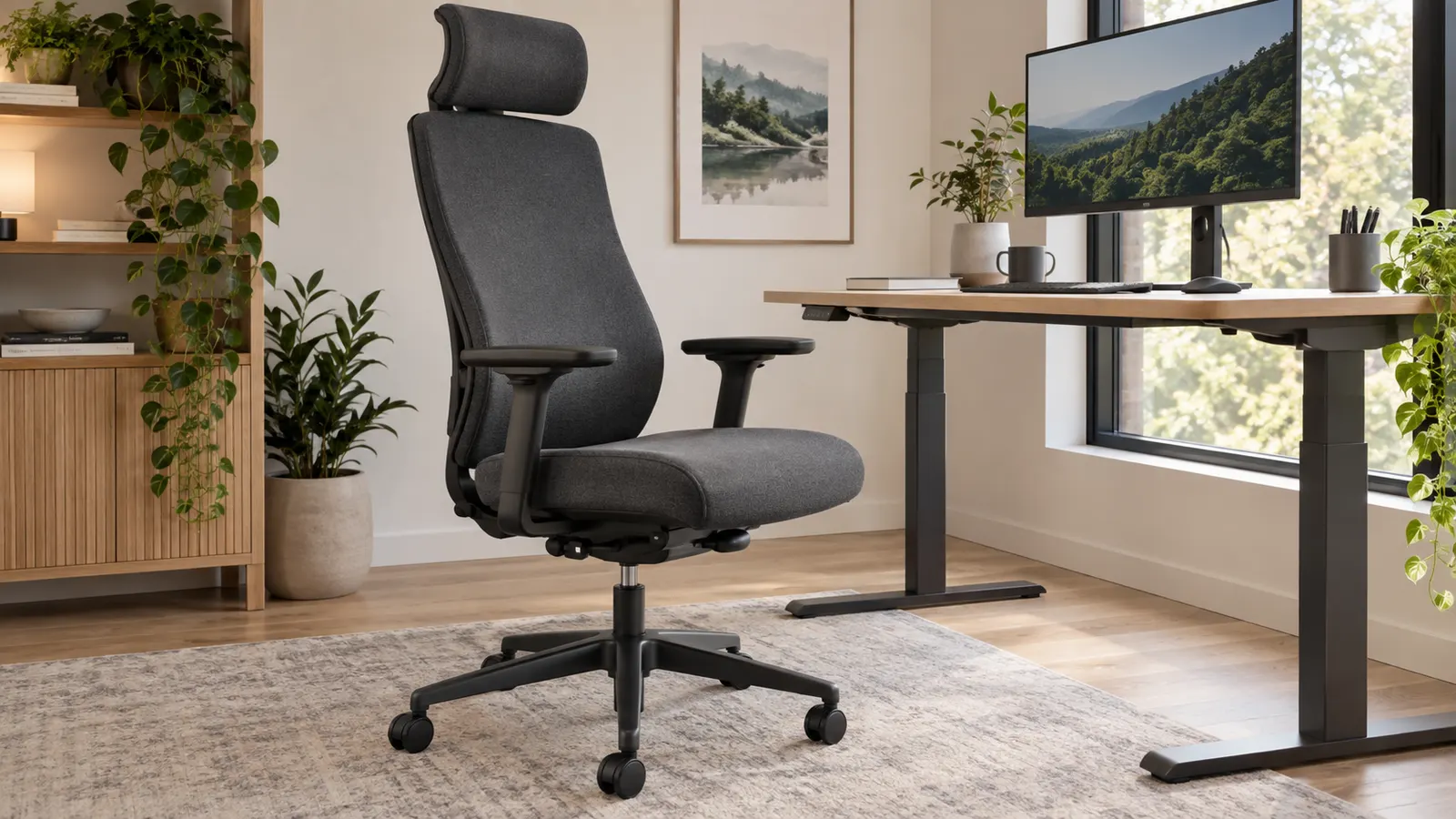
The original hero is a generated, generic editorial home-office scene. It is not a photograph of a MedHelperPro test space and does not depict any named chair.
Sources and further reading
- OSHA: chair fit, height, seat pan, backrest, and foot support
- OSHA: computer-workstation evaluation checklist
- CCOHS: selecting an office chair and work-chair adjustment guidance
- BIFMA: large-occupant office-chair standard context
- Systematic review: workplace chair interventions and fit limitations
- Oak Hollow: Aloria Leather with Headrest specifications, price, warranty, and returns
- Steelcase: Gesture product page, official brochure, and warranty
- Herman Miller: Aeron product sheet, 2026 size and fit reference, and warranty
- Haworth: Fern configuration, dimensions, price, warranty, and returns
- HON: Wave Big & Tall model details, warranty, and current retail listing
- Secretlab: TITAN Evo product page, technical specifications, and warranty terms
- Wirecutter: independent office-chair comparison
- Tom's Guide: independent office-chair coverage
- WIRED: independent office-chair coverage
Before you buy: Recheck the exact cylinder, seat-height range, seat depth, headrest, capacity, current price, stock, delivery, warranty, return deadline, packaging requirements, and fees on the seller's site. This guide is product research, not a hands-on comfort or fit test.