Best Anti-Fatigue Standing Mats: 5 Picks (2026)
Disclosure: This researched guide compares manufacturer specifications, prices, warranties, returns, safety guidance, and independent coverage. No affiliate links were added. MedHelperPro did not receive, stand on, compress, slip-test, or wear-test these mats.
Buy for movement, floor space, and storage.
Ergodriven Topo is the strongest fit for a standing-desk user who wants raised terrain for frequent foot changes. UPLIFT's Heel Grab mat is the practical value pick because it is flat, compact, and easy to pull from under a desk. Vari Standing Mat Pro suits heavy office use. WellnessMats Original offers a wide premium surface, while ComfiLife is the budget choice with several lengths.
FOR MOTION
An anti-fatigue mat can make hard flooring less punishing, but it should not turn standing into a contest. NIOSH's review of prolonged standing found that position changes and movement were the most consistent recommendation. A mat works best as one part of a sit, stand, and move routine.
The useful differences are easy to miss on a product page. Contours invite different stances but take more floor space. Flat mats store more easily and work better for steady standing. A thick, soft mat can feel pleasant for five minutes yet unstable later. Measure the floor, plan where the chair goes, then compare the return conditions.
Which anti-fatigue standing mat should you buy?
| Standing mat | Best use | Size and surface | Footwear and storage fit | Price and ownership checked Sept. 15 |
|---|---|---|---|---|
| Ergodriven Topo | Best overall for varied foot positions | 29 by 26.25 in; 0.85 in neutral area; raised terrain up to 2.7 in; polyurethane | Useful with socks or flexible shoes; needs open under-desk depth | $119 sale, $139 regular; free 90-day returns; warranty wording conflicts |
| UPLIFT Standing Desk Mat with Heel Grab | Best value and easiest to move | 30 by 18 by 0.75 in; rubberized gel foam; textured, beveled surface | Maker says shoes or socks; heel cutout helps pull it aside | $29 sale, $69 regular; 30-day like-new return; 15-year warranty |
| Vari Standing Mat Pro | Best flat mat for high-use offices | 32 by 20 by 0.75 in; 100% PU foam with integral skin; beveled edges | Flat surface suits shoes; 3 lb and no heel grab | $84.15 sale, $99 regular; free 30-day return; 10-year warranty |
| WellnessMats Original 3 by 2 | Best wide premium flat mat | 36 by 24 by 0.75 in; one-piece polyurethane; smooth sealed surface | Wide stance area; 7.6 lb; less convenient to move for a chair | $125.60 sale, $157 regular; 30-day buyer-paid return plus $10 fee; 20-year home warranty |
| ComfiLife Anti-Fatigue Floor Mat | Best budget choice with long sizes | 20 by 32, 20 by 39, or 24 by 70 in; 0.75-in high-density foam | Flat, wipe-clean surface; maker requires a dry, flat floor | $57.99 to $99.95; return and lifetime wording should be confirmed |
Price note: Direct US prices, availability, and policies were checked September 15, 2026. Promotions and seller terms can change. The sale price is useful only if the product, size, and return conditions still fit when you order.
How were these standing mats selected?
The shortlist favors purposeful differences, not five nearly identical foam rectangles. Each mat needed current first-party specifications, a credible direct purchase path, and a clear reason to choose it. We then checked dimensions, material, edge design, cleaning, storage friction, price, warranty, and returns.
- Support without excess softness: CCOHS warns that thicker and softer are not always better. The surface needs elasticity without making standing unstable.
- Movement and position changes: A mat should permit small stance changes. It does not replace sitting, walking, or changing tasks.
- Edge and floor safety: Beveled, flat edges and a non-slip base matter. Any mat can become a trip hazard if it curls, slides, or blocks a chair path.
- Real ownership fit: Floor depth, chair storage, cleaning, return condition, fees, and warranty exclusions can matter more than a sale.
A 2018 Applied Ergonomics systematic review found moderate evidence that cushioned materials reduce discomfort during prolonged standing, based on ten eligible studies. That supports the category, not a guaranteed winner. A four-hour University of Michigan study found lower discomfort on three of four mats compared with a hard surface, with no significant discomfort difference among the mats.
TechRadar's independent category method also checks thickness, material, durability, stain or water resistance, size, and raised movement features. Its ranking and scores were not copied. Current product facts here come from the manufacturers.
Should you choose a flat or contoured standing mat?
Choose a contoured mat when foot movement is the main reason for buying. Topo's center and raised edges create several places to shift, stretch, or rest a foot. The tradeoff is a deeper, taller object that can catch a chair wheel or crowd a shallow desk.
Choose a flat mat when you want a broad, predictable surface. UPLIFT, Vari, WellnessMats, and ComfiLife are easier to understand at a glance and work with many stances. Flat does not mean easy to store, though. A 36 by 24-inch, 7.6-pound mat still has to go somewhere when you sit.
The best answer may be no mat. A resilient floor, supportive footwear, frequent movement, and shorter standing periods can be enough. If the desk itself is too high or low, start with the standing desk comparison and the ergonomic workspace buying order. A mat cannot fix keyboard height or monitor placement.
Why is Ergodriven Topo the best overall?
Topo is the only pick built around varied foot placement. The full-size mat measures 29 inches wide and 26.25 inches deep. Its neutral area is 0.85 inch thick, while the highest terrain reaches 2.7 inches. That shape provides a center zone, side slopes, and raised edges without requiring a moving balance board.
The material is polyurethane with an integral skin. Ergodriven says the base is designed to move with one foot when unloaded but stay put when someone stands on it. That is attractive for sit-stand transitions, though the guide did not verify slip resistance on wood, vinyl, tile, or carpet.
The direct page showed $119, down from $139, with free shipping and free returns for 90 days. Warranty language conflicts: the product page says 16 years in one section and 7 years in another, while the company's support page says 7 years. Get the applicable term in writing. Best for: someone who changes foot position often. Skip it if: your chair must roll through the same 26-inch-deep zone or you prefer a completely flat surface.
Why is UPLIFT's Heel Grab mat the best value?
UPLIFT's mat solves the daily storage problem better than most flat designs. It measures 30 by 18 by 0.75 inches and has a half-circle heel cutout at the rear. Pull it toward you for standing, then nudge it under the desk before rolling the chair back.
The rubberized gel foam uses a closed-cell construction, a textured top, and beveled edges. UPLIFT says it works with shoes or socks and can be cleaned with soap and water. Those are manufacturer claims, not MedHelperPro test results. Barefoot users should still judge edge feel and firmness during the return window.
The current $29 sale price is unusually low against the $69 regular price. UPLIFT lists a 15-year warranty. Its 30-day return policy covers like-new products in original packaging, with free parcel return shipping in the contiguous United States. Best for: a small desk and a chair that shares the floor. Skip it if: you need more than 18 inches of depth or want raised terrain.
Is Vari Standing Mat Pro better for a busy office?
Vari's new Standing Mat Pro is the strongest flat choice for repeated office use on paper. It is 32 by 20 by 0.75 inches, weighs 3 pounds, and uses 100 percent polyurethane foam with an integral skin. Vari says the surface resists punctures and abrasion and carries National Floor Safety Institute certification.
The mat ships flat and uses low beveled edges. There is no heel cutout, so you pick it up or slide it when switching to a chair. The wipe-clean skin is useful around shared desks, but no cross-product abrasion or cleaning-cycle data are published.
The page showed $84.15, reduced from $99. Vari gives this Pro model a 10-year warranty and a free 30-day direct return. Original packaging may be required. Best for: a shared or high-use office that wants a simple flat mat. Skip it if: you want active terrain, a heel grab, or the lowest price.
Who should buy WellnessMats Original?
WellnessMats Original offers the largest flat standing zone in this group. The 3 by 2-foot version measures 36 by 24 by 0.75 inches and weighs 7.6 pounds. It uses one-piece polyurethane with a sealed, smooth surface and beveled edges. The manufacturer lists NFSI certification and says the mat is latex-free.
That width works for someone who shifts side to side or uses the mat at a kitchen counter after work. It is less convenient under a compact desk. The weight and 24-inch depth can make every sit-stand transition feel like furniture moving.
The Original 3 by 2 was $125.60 during a sale, normally $157. The home warranty covers defects for 20 years and includes a 7-year performance section. Returns require authorization within 30 days; buyer-remorse returns charge buyer-paid shipping and a $10 restocking fee. Best for: a permanent, wide standing zone. Skip it if: you move the mat several times a day or need a low-friction trial.
Is ComfiLife the best budget anti-fatigue mat?
ComfiLife is the budget-oriented choice when you want a plain mat or a longer runner. The direct page lists 20 by 32, 20 by 39, and 24 by 70-inch sizes, each 0.75 inch thick. Its high-density foam has a stain-resistant top and a non-slip bottom. The maker says to use it only on a dry, flat surface and keep it at room temperature.
Prices ranged from $57.99 to $99.95. The ownership language needs caution. The product page promises a lifetime money-back or replacement guarantee, while the company's written policy describes a 60-day money-back window, product registration, proof of purchase, original packaging, and no visible signs of use. Confirm which rule applies before relying on the broader promise.
Best for: a straightforward flat surface or a long standing area at a modest price. Skip it if: warranty clarity matters more than price, you need a heel grab, or your floor is damp or uneven.
Are anti-fatigue mats better barefoot, in socks, or in shoes?
There is no universal winner. Bare feet reveal surface texture and edge pressure quickly, but they also get less support from footwear. Socks reduce friction and can make a slick combination on some mats. Shoes add their own cushioning and arch support, which can change how soft or stable the mat feels.
CCOHS treats footwear, flooring, work design, and position changes as one system. Its guidance recommends comfortable footwear with heel and arch support for prolonged standing. That makes a buyer's usual work footwear the right test condition, not a staged five-minute barefoot tryout.
- Barefoot: Check whether contours press uncomfortably into the heel or arch and whether the beveled edge feels abrupt.
- Socks: Test slip at the top surface and as you step on and off. Stop if the combination feels insecure.
- Shoes: Make sure the mat remains stable and does not feel so soft that the ankles keep correcting.
This guide did not run the calendar's proposed barefoot, sock, and shoe comparison. Instead, use the seller's return window to repeat the same work task in your normal footwear, on the actual floor, at the desk's correct height.
What size standing mat fits your desk?
Measure the open floor area at standing height and the chair's full return path. Leave room around desk feet, power cables, and floor vents. Then mark the mat outline with painter's tape. The outline should let you stand with both feet centered and shift weight without stepping onto a hard edge.
Depth creates more problems than width. Topo reaches 26.25 inches deep, while UPLIFT uses only 18 inches. A deeper mat gives more stance options but reaches farther into the chair path. The under-desk footrest guide covers the seated alternative, and the desk movement guide compares standing with walking pads and balance boards.
Buyer's checklist before ordering
- Fix desk height first. The keyboard should not force the shoulders up or the wrists into a sharp angle.
- Map the chair path. Decide where the mat goes every time you sit. Do not plan to roll over it.
- Measure width and depth. Use floor tape before trusting a product photo.
- Choose flat or contoured. Buy terrain for stance variety and a flat mat for a predictable surface.
- Match your footwear. Test with the shoes, socks, or bare feet you actually use.
- Inspect every edge. Stop using a mat that curls, slides, tears, or becomes a trip hazard.
- Keep the packaging. UPLIFT, Vari, and ComfiLife place conditions on returns.
- Save policy evidence. Screenshot conflicting warranty or return language at checkout.
A floor mat and a desktop mat solve different problems. If you need a mouse and keyboard surface, compare materials and care in the desk mat guide. Do not place chair wheels on a soft standing mat unless its maker explicitly designs it for that use.
Frequently asked questions
How thick should an anti-fatigue mat be?
Thickness alone does not determine comfort. All four flat picks here are 0.75 inch thick, yet their materials and surfaces differ. CCOHS advises against assuming softer or thicker is better. Look for elasticity, a stable feel, beveled edges, and a surface that stays put on your floor.
Can you leave a standing mat under an office chair?
Do not roll a chair over a soft standing mat unless the manufacturer specifically permits it. Wheels can catch an edge, compress the material unevenly, or block a safe path. A heel grab can make daily removal easier. Otherwise, plan a storage spot before buying.
Do anti-fatigue mats help with back pain?
Research supports a modest comfort benefit from some cushioned surfaces during prolonged standing, but a mat is not a back-pain treatment. Results vary by mat and person. Persistent, severe, or worsening pain deserves advice from a qualified health professional, not another desk accessory.
How long should you stand at a standing desk?
No single schedule fits everyone. NIOSH emphasizes movement and position changes rather than continuous standing. Start with short periods, sit before discomfort builds, and walk when practical. A timer can support the habit, but pain is not a target to push through.
Research and testing limitations
MedHelperPro did not physically use these products. No barefoot, sock, shoe, compression, slip, stain, curl, odor, floor-finish, temperature, or long-term wear measurements were performed. Specifications, prices, stock, warranties, and return terms were checked September 15, 2026. Manufacturer performance claims remain attributed.
The editorial calendar proposed comparing barefoot, shoes, and socks. The repository contains no mat samples, controlled floors, participants, dated standing logs, repeated discomfort ratings, photos, or measurements. Publishing that comparison as completed would invent evidence. The guide instead gives readers a conservative return-window protocol using their real floor, desk, footwear, and work task.
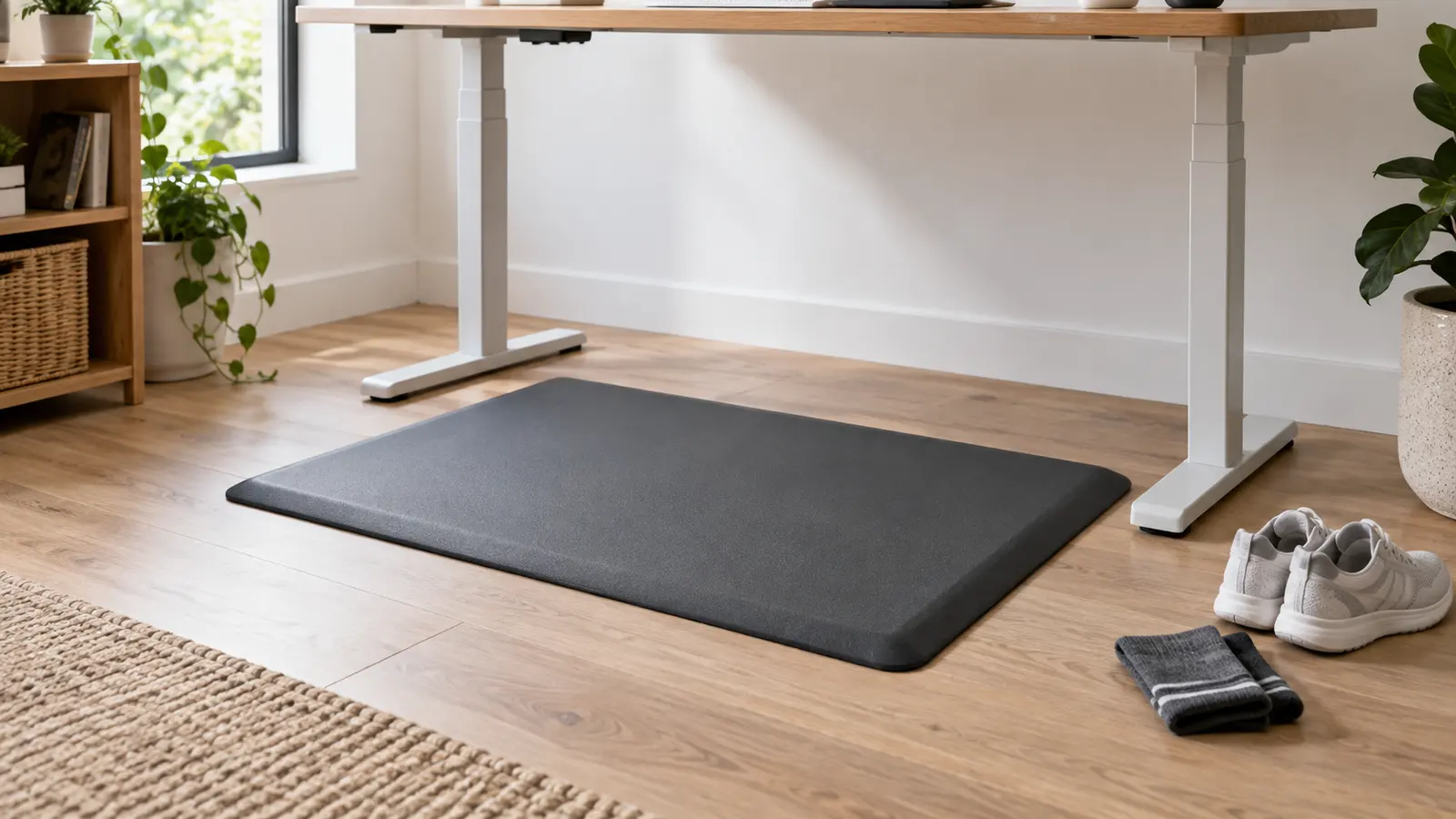
The original hero was generated as a generic editorial home-office scene. It is not a photograph of a MedHelperPro test area or any named mat.
Sources and further reading
- CCOHS: anti-fatigue mat selection, footwear, flooring, and position changes
- NIOSH: evidence and interventions for prolonged standing at work
- Applied Ergonomics: systematic review of cushioning materials during prolonged standing
- Human Factors: anti-fatigue mats, discomfort, and weight shifting
- Ergodriven: Topo dimensions, materials, price, returns, and product-page warranty
- Ergodriven: support-page return and warranty terms
- UPLIFT Desk: Heel Grab mat specifications, price, and warranty
- UPLIFT Desk: 30-day return policy and conditions
- Vari: Standing Mat Pro specifications, price, certification, warranty, and returns
- WellnessMats: Original collection price and sizes
- WellnessMats: home warranty terms
- WellnessMats: direct return process, shipping, and fee
- ComfiLife: mat sizes, price range, material claims, care, and guarantee wording
- ComfiLife: written return and replacement policy
- TechRadar: independent standing-mat selection and testing criteria
Before you buy: Recheck the exact size, material, price, stock, floor requirements, cleaning instructions, warranty, return condition, and fees on the seller's site. This guide is product research, not a hands-on comfort or safety test.