Best Office Chairs for Hip Pain: 5 Fit-First Picks (2026)
Affiliate disclosure: As an Amazon Associate I earn from qualifying purchases. MedHelperPro may earn a commission from eligible purchases made through links in this guide, at no extra cost to you. Affiliate availability does not affect our selections. Read the full disclosure.
Research note: Product selections are based on published specifications, policies, and independent evidence unless a guide explicitly describes hands-on testing.
Start with seat fit, not a therapeutic label.
Steelcase Amia is the best overall fit-first choice because its seat depth adjusts from 15.5 to 18.5 inches and the front edge flexes under the thighs. Haworth Very is the clearest waterfall-edge option. Haworth Assure is the lower-cost direct-buy pick, HON Ignition 2.0 is the value retailer choice when the exact controls are verified, and Herman Miller Embody is the premium option for buyers who can use its return window.
AMIA
An office chair cannot diagnose or treat hip pain. What it can do is avoid obvious fit conflicts: a seat that pinches at the sides, presses behind the knees, holds the hips too low, or prevents the feet from resting securely. Those conflicts are measurable before comfort claims are considered.
OSHA's chair guidance says the seat pan should support most of the thigh without contacting the back of the knee. Its evaluation checklist also calls for enough width and depth, cushioning, and a rounded waterfall front. These are workstation principles, not proof that a particular chair will reduce a person's symptoms.
Which office chair is the best fit for hip pressure?
| Chair | Seat fit evidence | Price and ownership | Best for | Main reason to skip |
|---|---|---|---|---|
| Steelcase Amia | 19.25 in wide; 15.5 to 18.5 in depth; flexible front edge | From $1,099 direct; 12-year warranty; direct returns available | Broad adjustment with a forgiving front edge | High price and no published foam-density number |
| Haworth Very | 19 in wide; 16 to 19 in depth; stated waterfall edge | $769 sale price checked; 12-year warranty; 30-day direct returns | Buyers who want an explicitly documented waterfall edge | Optional features and prices vary by configuration |
| Haworth Assure | 20 in wide; 16 to 19 in published depth; molded cushion | $360 direct; five-year warranty; 30-day direct returns | Lower-budget buyers who want a wider published seat | Product page does not clearly promise a user-adjustable depth slider |
| HON Ignition 2.0 | 20 in published seat width; seat glide offered in the family | Retailer price varies; lifetime frame coverage with shorter component terms | Value buyers who verify the exact model and controls | Ignition is a family, so features differ by configuration |
| Herman Miller Embody | 15 to 18 in adjustable depth; layered seat with elastic suspension | $2,305 configuration checked; 12-year warranty; 30-day direct returns | Premium buyers who will tune and trial the chair | Very expensive and adjustment feel is personal |
Prices and terms checked October 7, 2026. Direct prices, promotions, stock, configurations, seller terms, and warranty eligibility can change. Confirm the exact chair code before ordering.
How were these chairs selected?
This is a researched guide, not a hands-on pressure test. We compared manufacturer dimensions, adjustment instructions, warranties, and return policies, then used independent comparative coverage only as a cross-check on subjective comfort. We did not rank chairs by affiliate availability, customer-star averages, or medical promises.
- Seat-pan width: Published seat width was favored over total chair width. A seat should leave room to change posture without forcing the thighs against hard side bolsters or arm supports.
- Usable depth: A depth range is more useful than a single large pan. The back should meet the backrest while space remains behind the knees.
- Front-edge design: A rounded, flexible, or waterfall edge can reduce a hard contact point under the thighs. The label alone does not prove pressure distribution.
- Cushion construction: Most makers do not publish foam density. We report the construction they do document and treat a return window as part of the fit decision.
- Adjustment and ownership: Seat height, depth, recline, arm position, capacity, warranty, service route, and returns all affect whether a promising chair remains useful.
BIFMA explains that ANSI/BIFMA X5.1 evaluates office-chair safety, durability, and structural adequacy. That is valuable evidence, but it is not a comfort study or a guarantee that a seat will fit a particular body.
Chair-by-chair tradeoffs
Steelcase Amia: best overall for adjustable seat fit
Steelcase Amia publishes the most balanced seat-fit case in this group. Its seat is 19.25 inches wide, height adjusts from 16 to 21 inches, and depth adjusts from 15.5 to 18.5 inches. Steelcase also describes a passive front-seat flex of about 1.5 inches so the edge gives under the thighs rather than staying rigid.
The cushion uses adaptive bolstering around the sides and a flexible edge, but Steelcase does not publish a foam-density value on the store page. TechGearLab's comparative testing found Amia's seat especially soft and comfortable across its test group. That is useful independent experience, not a promise that every user will prefer the same cushion.
Steelcase lists a 400-pound capacity and a 12-year warranty for the chair under the stated terms. The direct store showed a starting price of $1,099 when checked. Best for: someone who needs a meaningful depth range and a front edge that flexes. Skip it if: the price is outside budget, a 19.25-inch seat is too narrow by your measurements, or you need a confirmed foam specification before buying.
Haworth Very: best documented waterfall edge
Haworth Very is the clearest answer for buyers who specifically want a waterfall edge because Haworth names that feature on the product page. The listed seat is 19 inches wide, 16 to 19 inches deep, and 16 to 21 inches high. Haworth's product overview describes 3 inches of seat-depth adjustment and an optional 5-degree forward tilt.
The store showed a $769 sale price from $905, free 30-day returns, and a 12-year warranty when checked. The capacity is listed as 350 pounds without forward tilt and 325 pounds with it. Those numbers are configuration dependent, so confirm the selected control package.
Best for: a buyer who wants explicit documentation for the rounded edge and enough return time to assess the seat. Skip it if: you need more than 19 inches of published seat width, cannot verify the selected controls, or expect the word waterfall to settle comfort without a trial.
Haworth Assure: best lower-cost direct-buy option
Haworth Assure was $360 direct when checked. Haworth lists a 20-inch seat width, 16 to 19 inches of published depth, 16 to 20 inches of height, a molded cushion, and a 300-pound capacity. The chair includes synchro tilt, upright lock, and height-adjustable arms.
There is an important ambiguity. The store page lists a depth range but does not clearly describe a user-operated seat-depth slider in the feature summary. Treat that number as a published dimension range until Haworth confirms the exact mechanism for the configuration in your cart. The chair carries a five-year warranty and the store listed free returns within 30 days.
Best for: a tighter budget, a wider published seat, and direct-store ownership terms. Skip it if: precise seat-depth adjustment is nonnegotiable, the 20-inch minimum seat height in your configuration would leave your feet unsupported, or you want a longer chair warranty.
HON Ignition 2.0: best value when the model is verified
HON's Ignition 2.0 functionality guide shows why model verification matters. The family can include a seat glide, adjustable lumbar, different tilt controls, and several arm packages. HON has published a 20-inch seat width and a 300-pound rating for common task configurations, but those family specifications do not make every listing identical.
The verified retailer listing in this guide is model HONI2M2AMLC10TK, described as the black mesh mid-back Ignition 2.0 with adjustable lumbar and advanced synchro tilt. Its ASIN is B06Y3PGPR2. Check that full model code at checkout rather than relying on the shorter Ignition name.
Check the verified HON Ignition 2.0 model on Amazon
HON's warranty gives the frame full-lifetime coverage for the original purchaser under its terms, while controls and cylinders are covered for 12 years and textiles for five. Dealer service can be useful, but seller return terms still apply. Best for: a value buyer willing to match the complete model code and control package. Skip it if: the listing hides the code, you cannot confirm the seat glide, or returning a built chair would be impractical.
Herman Miller Embody: best premium trial
Herman Miller Embody uses a four-layer seat with elastic suspension and independent support elements rather than a conventional thick foam pad. Its seat depth adjusts from 15 to 18 inches, seat height from 16 to 20.5 inches, and the chair is rated to 300 pounds.
The shown configuration was $2,305 with a 12-year warranty and a 30-day direct return window when checked. This is the choice where the ownership terms matter almost as much as the construction. TechGearLab's test group mostly rated its comfort highly, but one tester could not dial in the back support. That disagreement is a good reason to avoid treating a premium mechanism as a universal fit.
Best for: a high budget, willingness to learn the adjustments, and access to the direct return window. Skip it if: you cannot try or return it, prefer a simple cushion, or would be stretching the budget for an uncertain comfort result.
How should you measure seat-pan fit?
Measure the chair you already use before comparing a product page. Sit with your back meeting the backrest and both feet supported. A helper can measure the usable seat width between hard edges, the seat depth from the back contact point to the front, and the gap behind the knees.
- Check width at the body, not the base. Total chair width includes arms and controls. Compare your needed clearance with the published seat width and the space between the arm supports.
- Match depth with the back engaged. A deep pan can look roomy while pushing behind the knees once the back reaches the backrest. A shallow pan can leave too much thigh unsupported.
- Set height from the floor. Feet should rest securely with knees near hip level or slightly lower. NIOSH recommends flat feet or a footrest and hips and knees at about 90 degrees or slightly more open.
- Recheck the desk. Lowering the chair for foot contact can make the desk too high. A properly sized footrest can support the feet while preserving elbow height, but it cannot fix a seat that is too narrow or deep.
- Trial normal tasks. Use the keyboard, mouse, calls, and recline positions you actually need. Change posture rather than locking into a single idealized pose.
Which chair fits each budget and user?
- Lowest direct-store price: Assure gives the widest published seat here for $360, but buyers who need an active depth slider should get written confirmation first.
- Value with model checking: Ignition 2.0 makes sense when the full code proves the controls you need. It is not a safe blind recommendation across the whole family.
- Best fit-first upgrade: Amia combines a useful depth range with a flexible edge. Pay for it only if those measurements solve a real mismatch.
- Explicit waterfall priority: Very documents the feature directly. The 30-day return window is still the practical test of whether the edge lands correctly.
- Premium experiment: Embody offers unusual seat construction and broad tuning, but only a financially comfortable purchase with a usable return route makes sense.
If your main problem is backrest shape or lumbar tuning rather than seat contact, use the separate office-chair adjustment guide. Shorter users should compare minimum height and depth in the shorter-user chair guide; taller users can check maximum height and pan depth in the taller-user guide. Those are different buying questions from hip-area seat fit.
What should you verify before buying?
Match the product page to the exact configuration, then save a copy of the dimensions and return policy. Check whether a promotion changes return eligibility, who pays return shipping, whether assembly affects the return, and how warranty service is handled. For retailer purchases, the seller's policy may differ from the manufacturer's direct-store policy.
Look below the seat for hard brackets, side bolsters, or arm posts that narrow the usable surface. Confirm that the arms can clear the desk while keeping the mouse close. The broader ergonomic workspace setup guide covers desk, input, and monitor order so a new chair does not create a second mismatch.
Published foam density would make cushion comparisons easier, but it is absent for these configurations. Do not convert words such as molded, adaptive, or layered into a firmness score. Construction describes the design; only a real return trial tells you how that design fits you.
Frequently asked questions
Is a waterfall seat always better for hip pain?
No. A rounded edge can reduce a hard contact point under the thighs, but hip-area comfort also depends on width, depth, height, cushion response, backrest position, and movement. Waterfall is a design feature, not a treatment claim.
Should a chair seat be firm or soft?
Neither label predicts fit by itself. A very soft cushion can bottom out or make position changes harder. A firm surface can create pressure if its shape is wrong. Favor published construction, a usable return window, and enough time to assess normal work.
How much space should be behind the knees?
There is no single number that fits everyone. The practical check is whether the back can contact the backrest while the front edge avoids the back of the knees and still supports most of the thighs. OSHA's guidance uses that functional test.
Can a footrest make a chair fit?
A footrest can help when the seat must stay high enough for the desk and the feet otherwise hang. It cannot widen the seat, shorten an excessive pan, move hard side edges, or correct a poorly placed backrest.
Research and testing limitations
MedHelperPro did not possess, assemble, measure, sit in, pressure-map, or durability-test these chairs. No foam-density, interface-pressure, temperature, long-session comfort, rolling, recline, or wear test was performed. Manufacturer measurements can use different reference points, and configuration pages can change.
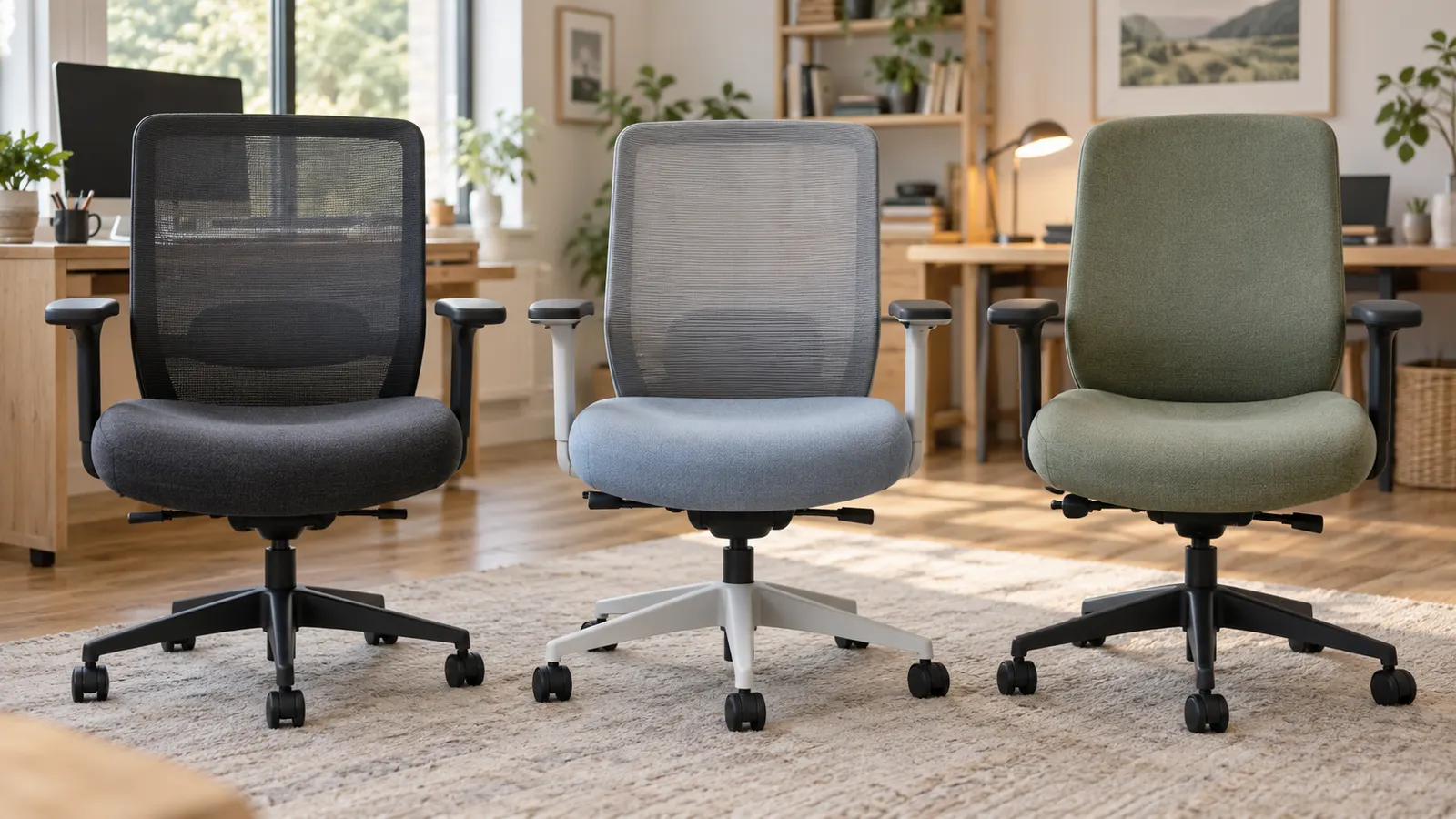
Prices and policies were checked on October 7, 2026. The hero is an original AI-generated editorial image of generic chairs, not a product photograph or evidence of possession. If hip pain is persistent, severe, worsening, follows an injury, or comes with weakness or numbness, seek advice from a qualified health professional rather than relying on a chair purchase.
Primary and independent sources
- OSHA: Computer Workstations, Chairs, Evaluation Checklist, and Purchasing Guide
- NIOSH: Working from Home
- BIFMA: ANSI/BIFMA X5.1 overview
- Steelcase: Amia store page and Amia product overview
- Haworth: Very Mesh Office Chair and Very product overview
- Haworth: Assure Office Chair
- HON: Ignition 2.0 functionality guide and HON warranty
- Herman Miller: Embody Chair and chair adjustments
- TechGearLab: Office chair comparative test and Embody test
Before you buy: Recheck the exact chair code, usable seat width, depth range, minimum and maximum height, capacity, arm clearance, current price, seller, return costs, and warranty. A feature name cannot replace a real fit check.