Best Wrist Rests for Keyboard and Mouse (2026)
Affiliate disclosure: As an Amazon Associate I earn from qualifying purchases. MedHelperPro may earn a commission from eligible purchases made through links in this guide, at no extra cost to you. Affiliate availability does not affect our selections. Read the full disclosure.
Research note: Product selections are based on published specifications, policies, and independent evidence unless a guide explicitly describes hands-on testing.
Match the support to the keyboard's front edge before choosing gel or foam.
Logitech MX Palm Rest is the best fit for most low-profile full-size keyboards because its published height is only 8 mm. HyperX Wrist Rest is the better conventional full-size choice if its unpublished height aligns with your board. Pick 3M WR420LE when you need platform adjustment, Kensington Duo Gel for a wipe-clean gel surface, or DeltaHub Carpio 2.0 for a mouse hand that moves across the desk.
PALM REST
A wrist rest should support the heel of the palm during pauses, not pin the wrist while the fingers move. The right product keeps the hands close to a straight line with the forearms. The wrong height can bend the wrist up, while pressure directly under the wrist can make an otherwise soft pad uncomfortable.
That makes height and slope more important than a soft material label. OSHA advises keeping the keyboard directly in front, the shoulders relaxed, the elbows close, and the wrists straight. If the desk or chair puts the keyboard too high, fix that mismatch before adding another layer.
Which wrist rest should you buy?
| Product | Best for | Material and fit | Ownership | Main reason to skip |
|---|---|---|---|---|
| Logitech MX Palm Rest | Low-profile full-size keyboards | Memory foam; 420 mm wide, 64 mm deep, 8 mm high | $22.99 direct; 30-day direct returns | Too low for many tall keyboard cases |
| HyperX Wrist Rest, Full Size | Full-size conventional or mechanical keyboards | Cool-gel memory foam; 457 mm wide, 88 mm deep | $22.99 direct; two-year warranty; 30-day returns | Maker does not publish height |
| 3M WR420LE | Keyboard angle and height adjustment | Gel rest on an adjustable platform; 19.6 by 10.6 inches overall | Two-year warranty; seller return terms vary | Large footprint and added platform |
| Kensington Duo Gel | Wipe-clean gel and a wide keyboard | Twin gel pillows with ventilation channel | Two-year limited warranty; seller terms vary | No published height and divided pressure feel |
| DeltaHub Carpio 2.0 | Mouse use with a moving palm support | Hand-specific silicone pads on a PTFE-gliding base | $34.90 direct; 60-day return or exchange | Hand sizing and low-profile device limits |
Prices and terms checked October 2, 2026. Prices, stock, seller, warranty eligibility, and return terms can change. The 3M and Kensington prices depend on the retailer, so this guide does not print a single current price for either.
How were these wrist rests selected?
This is a researched comparison, not a hands-on comfort ranking. The shortlist favors published dimensions, a clear use case, support materials that can be cleaned, and ownership terms that make a fit mistake less costly. Medical treatment claims and customer-star averages did not affect selection.
- Height match: The top should meet the keyboard's front edge without forcing the hand upward. Published height earned more confidence than an unlabeled product profile.
- Width and movement: A keyboard rest should cover the typing area. A mouse support must allow the hand to travel without making the user reach from the shoulder.
- Compression and surface: Memory foam changes under load, while gel usually feels more stable. Neither material is automatically more ergonomic.
- Durability evidence: Stitched edges, wipe-clean covers, replacement policies, and warranty length matter more than color.
- Ownership risk: Dimensions, size variants, return windows, and hand-specific designs were checked before features.
CCOHS recommends a relatively soft support with rounded edges that matches the width, height, and slope of the keyboard's front edge. It also suggests at least 3.8 cm, or 1.5 inches, of depth. The hands should move freely and remain elevated while typing.
Why is Logitech MX Palm Rest best for low-profile keyboards?
Logitech MX Palm Rest is the easiest recommendation when the keyboard has a low front lip. Logitech's published business data lists the rest at 420 mm wide, 64 mm deep, and 8 mm high. That low profile pairs naturally with MX Keys and other slim full-size boards, while the 420 mm width covers nearly all of a standard typing area.
The surface uses memory foam with a stain-resistant coating and a non-slip underside. Logitech listed it at $22.99 and in stock when checked, with free returns within 30 days on the US store. The standalone page did not clearly state a dedicated warranty, so buyers who care about coverage should confirm the exact terms before ordering.
Best for: a low-profile full-size or compact keyboard whose front edge sits close to 8 mm. Skip it if: the keyboard case is clearly taller, you want a firmer gel surface, or you need a tenkeyless-width rest that leaves more mouse room.
View Logitech's product page and current terms. Check the verified Logitech MX Palm Rest listing on Amazon
When is HyperX Wrist Rest the better keyboard choice?
HyperX Wrist Rest, Full Size suits a taller full-size board when the actual height match works. HyperX publishes a 457 by 88 mm footprint, cool-gel memory foam, a natural-rubber anti-slip base, and anti-fray stitching. The company lists tenkeyless and 60 to 65 percent versions as separate size choices, which is useful if a long rest would push the mouse farther away.
HyperX listed the full-size model at $22.99, backed by a two-year warranty and a 30-day hassle-free return policy. The missing number is height. Measure the keyboard's front edge and compare the product in person or use the return window rather than assuming that a thick-looking foam rest is correct.
Tom's Hardware reported that its staff had used the HyperX rest for more than eight months and found it comfortable and durable. That is useful independent experience, but it does not settle fit for a different keyboard or hand position.
Best for: full-size, tenkeyless, or compact keyboard users who can match the correct variant and verify height. Skip it if: you need a published height before ordering, dislike compressible foam, or regularly spill liquids near the keyboard.
Who should choose the 3M WR420LE platform?
3M WR420LE is different from a loose pad. It combines an easy-clean gel wrist rest with a keyboard platform that can change tilt. The complete unit measures 19.6 by 10.6 by 1 inch. That can solve a keyboard-angle problem at the same time as palm support, but it also demands much more desk depth than a standalone strip.
3M publishes a two-year warranty and antimicrobial surface protection. That treatment protects the product surface; it is not a promise about the user's health. Retailer prices and return terms vary, and the platform must fit the keyboard without blocking controls or creating an unstable edge.
Best for: a fixed desk where a keyboard platform provides a useful angle change. Skip it if: desk depth is limited, the keyboard already sits at the correct height, or you want a portable support for several work locations. A desk mat can protect the surface, but it cannot correct a platform that is too high.
Is Kensington Duo Gel worth choosing?
Kensington Duo Gel is the wipe-clean option for users who prefer a stable gel feel. Its two gel pillows leave a ventilation channel through the center. Kensington says the surface resists common cleaning fluids under its MIL-STD-810H Method 504.3 testing and provides a two-year limited warranty.
The product page does not publish a height, so the same measurement rule applies. Color variants also use different model numbers. The gray US model is K62395US; confirm the model rather than assuming that every color or regional listing has the same seller and return terms.
TechGearLab's comparative test found the Duo Gel comfortable but reported an uneven feel between the two wrist positions. That split design may suit one user and annoy another.
Best for: a shared or easy-clean workspace where gel feels better than foam. Skip it if: the keyboard height is unknown, you prefer a flat continuous surface, or the divided pillows put pressure in the wrong place.
Does a moving mouse support make sense?
DeltaHub Carpio 2.0 moves with the mouse hand instead of staying fixed on the desk. The support has silicone contact pads, a PTFE-gliding base, and distinct left- and right-hand versions. The small size measures 8.5 by 3.8 by 1.5 cm and weighs 17 g; the large is 9.5 by 4.5 by 1.7 cm and weighs 22 g.
DeltaHub listed a single support at $34.90 with a 60-day money-back or exchange period. The maker says the standard model fits keyboards with a front edge below 1.5 cm and may sit too low beside higher mechanical keyboards or tall vertical mice. That is manufacturer fit guidance, not an independent ergonomic finding.
The Carpio is not a medical device, and the product disclaimer says it is not intended to diagnose, treat, cure, or prevent a condition. Best for: mouse users who want palm contact to travel across a smooth desk or mat. Skip it if: you switch hands, use a high mouse, dislike a moving object under the palm, or cannot confirm the hand size.
How should you match a wrist rest to three keyboard heights?
The calendar's useful test is a fit check across low, medium, and tall front edges. It does not require a laboratory. Use a ruler, view the hand from the side, and reject any rest that creates a visible step up or down.
- Measure the front edge. Measure from the desk to the keyboard case where the palm approaches it, not to the top of a keycap. Do this with the keyboard feet in the position you use.
- Low-profile board: Start around the MX Palm Rest's published 8 mm height. The goal is a nearly level transition, not a soft ramp that lifts the hands.
- Conventional office board: Compare the compressed height of the pad with the front edge. Uncompressed foam measurements can be misleading.
- Tall mechanical-style board: A thicker support may fit, but raising the keyboard or extending its rear feet can still increase wrist extension. Try a neutral board angle first.
- Check typing and pauses separately. Let the hands float while typing. During a pause, contact should land on the heel of the palm rather than the narrow wrist joint.
Take a side photo or ask another person to look for a bend at the wrist. Then type normally for 10 minutes and move between letters, number row, shortcuts, and mouse. Stop if the rest creates pressure or a forced angle. This buying guide cannot assess an individual health concern.
What should you check for mouse support?
A fixed mouse pad with a raised rest can work during pauses, but it should not trap the wrist while the hand reaches across the pointer area. OSHA recommends keeping the pointer close and on the same plane as the keyboard. CCOHS notes that research on wrist rests is inconclusive and that incorrect use can place pressure on the carpal tunnel or restrict blood flow.
Use the forearm and elbow to move the pointer rather than planting the wrist and sweeping the hand side to side. A narrower keyboard can create more mouse space than any pad. The ergonomic keyboard and mouse guide compares board width, mouse size, and connection choices that affect that reach.
Which choice fits each budget?
- Spend nothing first: Flatten the keyboard feet, bring the board closer, lower the work surface if possible, and remove pressure from the desk edge. A folded towel is not a stable long-term product test, but it can reveal whether added height makes the angle worse.
- About $23: Choose Logitech for a measured low front edge or HyperX when its variant and height match. Do not let identical list prices decide the fit.
- About $35: Consider Carpio only when the moving, hand-specific design matches the mouse and desk surface.
- Higher budget: Pay for 3M's adjustable platform only if the platform solves a real keyboard-position problem. Adjustment that you do not need is extra bulk.
Keep the box until the full setup passes several normal work sessions. Foam can feel different after it warms and compresses. Gel can feel stable but may expose pressure points quickly. Clean only with the maker's recommended method, and replace a rest when the cover splits, the base slides, or the center no longer returns to shape.
Frequently asked questions
Should wrists touch the rest while typing?
No. The hands should move freely while typing. Use the support under the heel of the palm during pauses. Continuous pressure directly under the wrist can restrict movement and may be uncomfortable.
Is gel better than memory foam?
Neither is universally better. Gel usually holds a more stable shape and is often easy to wipe. Memory foam spreads pressure but compresses, warms, and can lose shape. Height match, edge shape, cover durability, and personal preference matter more than the material name.
Can a wrist rest fix wrist pain?
A support is not a treatment and cannot diagnose the reason for pain. It may improve a specific height or edge mismatch, but keyboard position, desk height, mouse reach, workload, and technique also matter. This guide cannot assess symptoms or recommend treatment.
Does every keyboard need a wrist rest?
No. A low, well-positioned keyboard may already allow neutral wrists without a pad. Buy a rest only when it improves the measured transition and does not add pressure. The ergonomic workspace setup guide explains why chair and desk height come first.
Research and testing limitations
MedHelperPro did not possess, measure, compress, clean, or type with these products. No instrumented wrist-angle, pressure, temperature, durability, slip, or long-session comfort test was performed. Published dimensions may use different reference points, and HyperX, Kensington, and some retailer listings do not publish every height needed for a precise comparison.
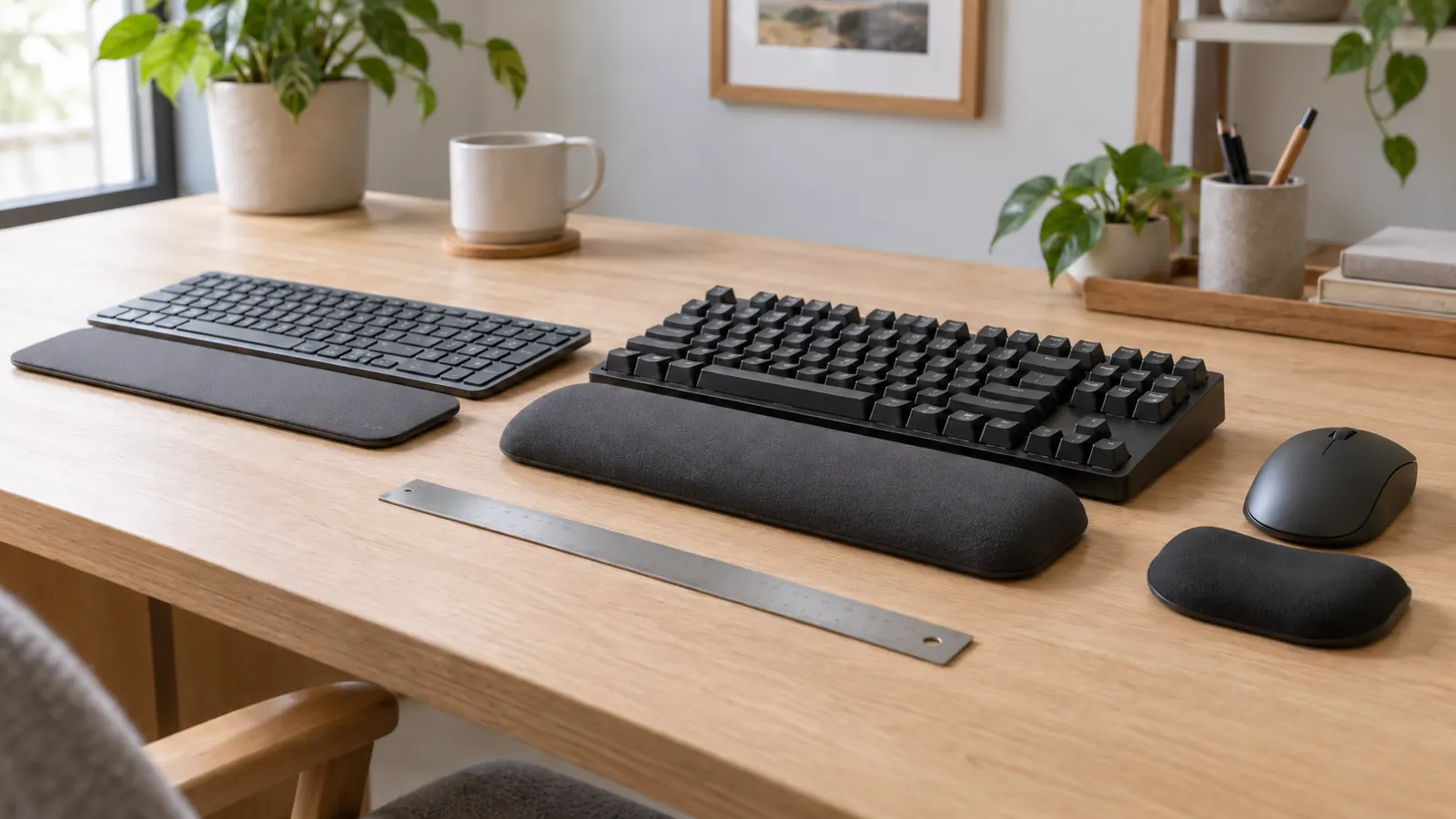
Prices and policies were checked on October 2, 2026. The hero image is an original AI-generated editorial illustration of generic equipment, not a product photograph or evidence of possession. Product order is based on fit transparency and use case, not affiliate commission.
Primary and independent sources
- OSHA: Computer Workstations, Keyboards and Pointer/Mouse
- Canadian Centre for Occupational Health and Safety: Wrist Rests and Mouse Selection and Use
- Logitech: MX Palm Rest and MX Keys Combo Business Gen 2 data sheet
- HyperX: Wrist Rest, Full Size
- 3M: Gel Wristrest Platform WR420LE
- Kensington: Duo Gel Wave Keyboard Wrist Rest
- DeltaHub: Carpio 2.0
- TechGearLab: Wrist Rest comparative test
Before you buy: Recheck the keyboard front-edge height, rest dimensions, compressed height, model or hand variant, current price, seller, warranty, and return terms. A soft material cannot compensate for a poor workstation height.